Cloud-clone
SKU:APA129Hu01
Active Tissue Inhibitors Of Metalloproteinase 3 (TIMP3)
Active Tissue Inhibitors Of Metalloproteinase 3 (TIMP3)
Couldn't load pickup availability
Product No.
APA129Hu01
Organism Species
Homo sapiens (Human).
Buffer Formulation
20mM Tris, 150mM NaCl, pH8.0, containing 1mM EDTA, 1mM DTT, 0.01% SKL, 5% Trehalose and Proclin300.
Traits
Freeze-dried powder
Purity
> 90%
Isoelectric Point
9.3
Applications
Cell culture; Activity Assays.
UOM
10µg 50µg 200µg 1mg 5mg
ACTIVITY TEST
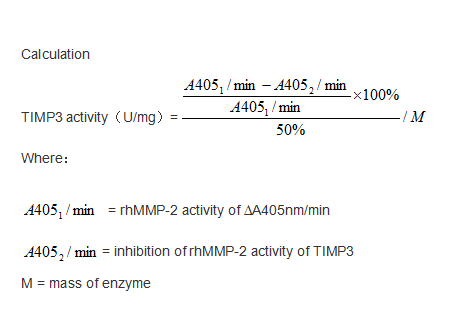
Tissue Inhibitors Of Metalloproteinase 3 (TIMP3) is an protein belongs to the tissue inhibitor of metalloproteinases family. They are inhibitors of the matrix metalloproteinases. TIMP-3 is the only member of the TIMP family which is found exclusively in the extracellular matrix (ECM). It is regulated in a cell cycle-dependent fashion in certain cell types and may serve as a marker for terminal differentiation. The activity of recombinant human TIMP3 was measured by its ability to inhibit recombinant human MMP2 cleavage of a fluorogenic peptide substrate Mca-PLGL-Dpa-AR-NH2 in the assay buffer 50 mM Tris, 10 mM CaCl2, 150 mM NaCl, 0.05% Brij-35 (v/v), pH 7.5. The rhMMP-2 (APA100Hu61) was activated with 1 mM APMA at 37 °C for 1h. Then 16 μl 126 ug/mL rhTIMP-3, 25.6 µL of 100 ug/ml rhMMP-2 and 118.4 µL of assay buffer was incubated for 2 hours at 37 °C, including a control (in duplicate) containing assay buffer and the diluted rhMMP-2. The mixtures was diluted 5 fold in assay buffer followed by adding 50 ul 20 uM substrate, including a control containing assay buffer and substrate. Then read at excitation and emission wavelengths of 320 nm and 405 nm (top read), respectively in kinetic mode for 5 minutes. Under these conditions, the enzyme amount of 50% inhibition of rhMMP-2 activity per minute is defined as a unit. The specific activity of TIMP3 is >6000 U/mg.
USAGE
Reconstitute in 20mM Tris, 150mM NaCl (pH8.0) to a concentration of 0.1-1.0 mg/mL. Do not vortex.
STORAGE
Avoid repeated freeze/thaw cycles. Store at 2-8°C for one month. Aliquot and store at -80°C for 12 months.
STABILITY
The thermal stability is described by the loss rate. The loss rate was determined by accelerated thermal degradation test, that is, incubate the protein at 37°C for 48h, and no obvious degradation and precipitation were observed. The loss rate is less than 5% within the expiration date under appropriate storage condition.
| Magazine | Citations |
| Neuroimmunomodulation | Upregulated Expression of Matrix Metalloproteinases and Tissue Inhibitors of Matrix Metalloproteinases in BALB/c Mouse Brain Challenged with Japanese Encephalitis Virus Pubmed: source |
| Experimental Biology and Medicine | Acidic pH conditions mimicking degenerative intervertebral discs impair the survival and biological behavior of human adipose-derived mesenchymal stem cells Rsmjournals: Source |
| PLoS ONE | A Combinatorial Relative Mass Value Evaluation of Endogenous Bioactive Proteins in Three-Dimensional Cultured Nucleus Pulposus Cells of Herniated Intervertebral Discs: Identification of Potential Target Proteins for Gene Therapeutic Approaches Plosone: Source |
| Physiol. Res. | The unwounded skin remodeling in animal models of diabetes types 1 and 2. Pubmed: 24020818 |
| VirusDisease | Circulating levels of matrix metalloproteinases and tissue inhibitors of matrix metalloproteinases during Japanese encephalitis virus infection Pubmed:26925446 |
| Acta Pharmacol Sin. | Pharmacological evidence: a new therapeutic approach to the treatment of chronic heart failure through SUR2B/Kir6.1 channel in endothelial cells. pubmed:27890915 |
| Biochemical genetics | Comparison of Selected Protein Levels in Tumour and Surgical Margin in a Group of Patients with Oral Cavity Cancer pubmed:28421310 |
| International Journal of Cancer | Circulating and tissue IMP3 levels are correlated with poor survival in renal cell carcinoma Pubmed: 30650187 |
| J. Pers. Med | Altered TIMP-3 Levels in the Cerebrospinal Fluid and Plasma of Patients with Alzheimer's Disease Pubmed:35629249 |