Cloud-clone
SKU:APC206Hu01
Active Histone Deacetylase 1 (HDAC1)
Active Histone Deacetylase 1 (HDAC1)
Couldn't load pickup availability
Product No.
APC206Hu01
Organism Species
Homo sapiens (Human).
Buffer Formulation
20mM Tris, 150mM NaCl, pH8.0, containing 1mM EDTA, 1mM DTT, 0.01% SKL, 5% Trehalose and Proclin300.
Traits
Freeze-dried powder
Purity
> 95%
Isoelectric Point
5.3
Applications
Cell culture; Activity Assays.
UOM
10µg 50µg 200µg 1mg 5mg
ACTIVITY TEST
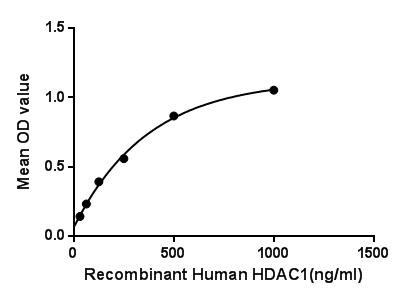
Figure. The binding activity of HDAC1 with Sp1.
Histone deacetylase 1 (HDAC1) is an enzyme which belongs to the histone deacetylase/acuc/apha family and is a component of the histone deacetylase complex. Histone acetylation and deacetylation, catalyzed by multisubunit complexes, play a key role in the regulation of eukaryotic gene expression. HDAC1 also interacts with retinoblastoma tumor-suppressor protein and this complex is a key element in the control of cell proliferation and differentiation. Besides, Specificity Protein 1 (Sp1) has been identified as an interactor of HDAC1, thus a binding ELISA assay was conducted to detect the interaction of recombinant human HDAC1 and recombinant human Sp1. Briefly, HDAC1 were diluted serially in PBS, with 0.01% BSA (pH 7.4). Duplicate samples of 100uL were then transferred to Sp1-coated microtiter wells and incubated for 2h at 37℃. Wells were washed with PBST and incubated for 1h with anti-HDAC1 pAb, then aspirated and washed 3 times. After incubation with HRP labelled secondary antibody, wells were aspirated and washed 3 times. With the addition of substrate solution, wells were incubated 15-25 minutes at 37℃. Finally, add 50µL stop solution to the wells and read at 450nm immediately. The binding activity of of HDAC1 and Sp1 was shown in Figure 1, and this effect was in a dose dependent manner.
USAGE
Reconstitute in 20mM Tris, 150mM NaCl (pH8.0) to a concentration of 0.1-1.0 mg/mL. Do not vortex.
STORAGE
Avoid repeated freeze/thaw cycles. Store at 2-8°C for one month. Aliquot and store at -80°C for 12 months.
STABILITY
The thermal stability is described by the loss rate. The loss rate was determined by accelerated thermal degradation test, that is, incubate the protein at 37°C for 48h, and no obvious degradation and precipitation were observed. The loss rate is less than 5% within the expiration date under appropriate storage condition.
| Magazine | Citations |
| Journal of Integrative Medicine | Saponins isolated from roots of Chlorophytum borivilianum reduce acute and chronic inflammation and histone deacetylase Pubmed:25609369 |
| Tzu Chi Medical Journal | Effects of tetrandrine and caffeine on cell viability and expression of mammalian target of rapamycin, phosphatase and tensin homolog, histone deacetylase 1, and histone acetyltransferase in glioma cells Science: Article |
| Restor Neurol Neurosci | Uridine protects against hypoxic-ischemic brain injury by reducing histone deacetylase activity in neonatal rats PubMed: 26410212 |
| Pharmacol Biochem Behav | Lacosamide reduces HDAC levels in the brain and improves memory: Potential for treatment of Alzheimer's disease PubMed: 25931268 |
| 网页打不开 | Effects of caffeine on cell viability and activity of histone deacetylase 1 and histone acetyltransferase in glioma cells S1016319016300295 |