

Cloud-clone
SKU:APA043Mu01
Active Glial Cell Line Derived Neurotrophic Factor (GDNF)
Active Glial Cell Line Derived Neurotrophic Factor (GDNF)
Couldn't load pickup availability
Product No.
APA043Mu01
Organism Species
Mus musculus (Mouse).
Buffer Formulation
20mM Tris, 150mM NaCl, pH8.0, containing 1mM EDTA, 1mM DTT, 0.01% SKL, 5% Trehalose and Proclin300.
Traits
Freeze-dried powder
Purity
> 97%
Isoelectric Point
8.9
Applications
Cell culture; Activity Assays.
UOM
10µg 50µg 200µg 1mg 5mg
ACTIVITY TEST
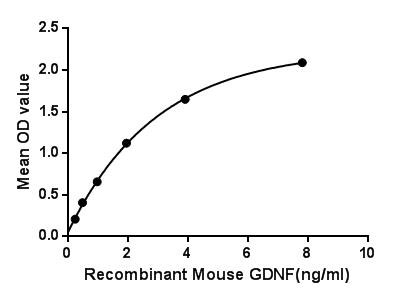
Figure. The binding activity of GDNF with GFRa2.
Glial cell-derived neurotrophic factor (GDNF) is a small protein that potently promotes the survival of many types of neurons. This protein was shown to promote the survival and differentiation of dopaminergic neurons in culture, and was able to prevent apoptosis of motor neurons induced by axotomy. The most prominent feature of GDNF is its ability to support the survival of dopaminergic and motorneurons. Besides, Glial Cell Line Derived Neurotrophic Factor Receptor Alpha 2 (GFRa2) has been identified as an interactor of GDNF, thus a binding ELISA assay was conducted to detect the interaction of recombinant mouse GDNF and recombinant mouse GFRa2. Briefly, GDNF were diluted serially in PBS, with 0.01% BSA (pH 7.4). Duplicate samples of 100uL were then transferred to GFRa2-coated microtiter wells and incubated for 2h at 37℃. Wells were washed with PBST and incubated for 1h with anti-GDNF pAb, then aspirated and washed 3 times. After incubation with HRP labelled secondary antibody, wells were aspirated and washed 3 times. With the addition of substrate solution, wells were incubated 15-25 minutes at 37℃. Finally, add 50µL stop solution to the wells and read at 450nm immediately. The binding activity of GDNF and GFRa2 was shown in Figure 1, and this effect was in a dose dependent manner.
USAGE
Reconstitute in 20mM Tris, 150mM NaCl (pH8.0) to a concentration of 0.1-1.0 mg/mL. Do not vortex.
STORAGE
Avoid repeated freeze/thaw cycles. Store at 2-8°C for one month. Aliquot and store at -80°C for 12 months.
STABILITY
The thermal stability is described by the loss rate. The loss rate was determined by accelerated thermal degradation test, that is, incubate the protein at 37°C for 48h, and no obvious degradation and precipitation were observed. The loss rate is less than 5% within the expiration date under appropriate storage condition.
| Magazine | Citations |
| Molecular Neurobiology | Efficient Generation of Functionally Active Spinal Cord Neurons from Spermatogonial Stem Cells pubmed:27566610 |
| Chinese Medicial Journal | Safflower Extract and Aceglutamide Injection Promoting Recovery of Peripheral Innervations via Vascular Endothelial Growth Factor-B Signaling in Diabetic Mice PMC5717862 |
| The Chinese Journal of Integrated Traditional and Western Medicine Press and Springer-Verlag Berlin Heidelberg | Acupuncture Alters Pro-infl ammatory Cytokines in the Plasma of Maternally Separated Rat Pups pubmed:28986807 |
| Heroin Addiction And Related Clinical Problems | GDNF serum levels are found to be lower in opioid-maintained patients ISSN 2531-4122 |
| Journal of Environmental Research and Public Health | Effects of 220 MHz Pulsed Modulated Radiofrequency Field on the Sperm Quality in Rats Pubmed: 30974849 |
| Frontiers in Aging Neuroscience | The Effects of Nordic Walking With Poles With an Integrated Resistance Shock Absorber on Cognitive Abilities and Cardiopulmonary Efficiency in … Pubmed: 33192480 |
| EUROPEAN CHILD & ADOLESCENT PSYCHIATRY | Increased serum brain-derived neurotrophic factor and adrenocorticotropic hormone levels are associated with obsessive compulsive disorder in medication?free?¡ 33389158 |
| Int J Biol Macromol | The effect of biodegradable silk fibroin-based scaffolds containing glial cell line-derived neurotrophic factor (GDNF) on the corneal regeneration process 34119551 |
| Inflammopharmacology | Silymarin constrains diacetyl-prompted oxidative stress and neuroinflammation in rats: involvements of Dyn/GDNF and MAPK signaling pathway Pubmed:35366745 |
| Molecular Biology Reports | Umbilical cord-derived mesenchymal stem cell conditioned medium reverses neuronal oxidative injury by inhibition of TRPM2 activation and the JNK signaling … Pubmed:35585377 |
