Cloud-clone
SKU:APC744Ra61
Active Peptidylglycine Alpha Amidating Monooxygenase (PAM)
Active Peptidylglycine Alpha Amidating Monooxygenase (PAM)
Couldn't load pickup availability
Product No.
APC744Ra61
Organism Species
Rattus norvegicus (Rat).
Buffer Formulation
PBS, pH7.4, containing 0.01% SKL, 1mM DTT, 5% Trehalose and Proclin300.
Traits
Freeze-dried powder
Purity
> 95%
Isoelectric Point
5.7
Applications
Cell culture; Activity Assays.
UOM
10µg 50µg 200µg 1mg 5mg
ACTIVITY TEST
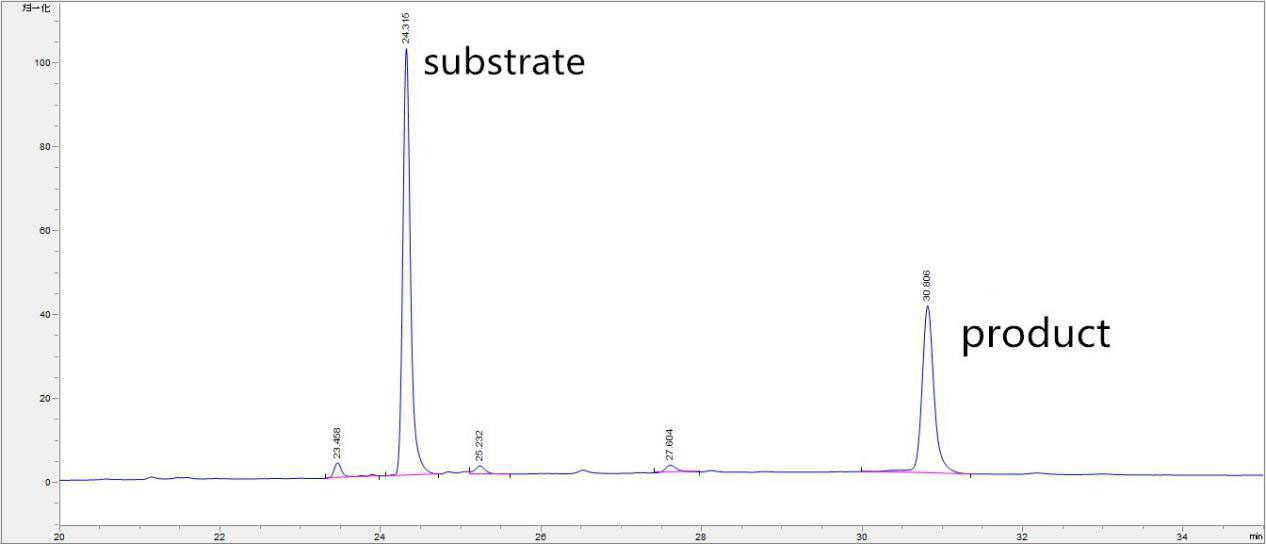
Figure. Recombinant Rat PAM activity assay by HPLC.
Peptidyl-glycine alpha-amidating monooxygenase (PAM) is an enzyme that is required for the biosynthesis of many signaling peptides. It has two enzymatically active domains with catalytic activities-peptidylglycine alpha-hydroxylating monooxygenase (PHM) and peptidyl-alpha-hydroxyglycine alpha-amidating lyase (PAL). These catalytic domains work sequentially to catalyze neuroendocrine peptides to active alpha-amidated products. A typical activity assay using Dns-Tyr-Val-Gly as substrate, thus the recombinant rat PAM activity was measured by its ability to hydrolyze Dns-Tyr-Val-Gly to Dns-Tyr-Val-NH2. The reaction was preformed in 1mL containing 100mM MES/KOH pH 6.0, 30mM KI, 30mM KCl, 1μmol/L cupric sulfate, 100ug/mL catalase, 1% (v/v) ethanol, 0.001% (v/v) Triton X-100, 10mM ascorbate, 0.35mM/L Dns-Tyr-Val-Gly (0.2mg/mL) and initiated by addition various concentrations of PAM (0.1ug/mL, 1ug/mL, 5ug/mL). Incubated at 37℃ for 30min, the reaction stopped by addition 6% (v/v) TFA. The product and substrate was detected by RP-HPLC with UV-detection at 280nm, the analyses were performed at 25℃ employing a Agilent ZORBAX Poroshell SB C18 column (9.4×250mm, 5μm), the flow rate was 1ml/min. The mobile phase consisited of 100 mM sodium acetate (pH 6.5) and 35min linear gradient of 10-90% acetonitrile. The result was shown in Figure 1.
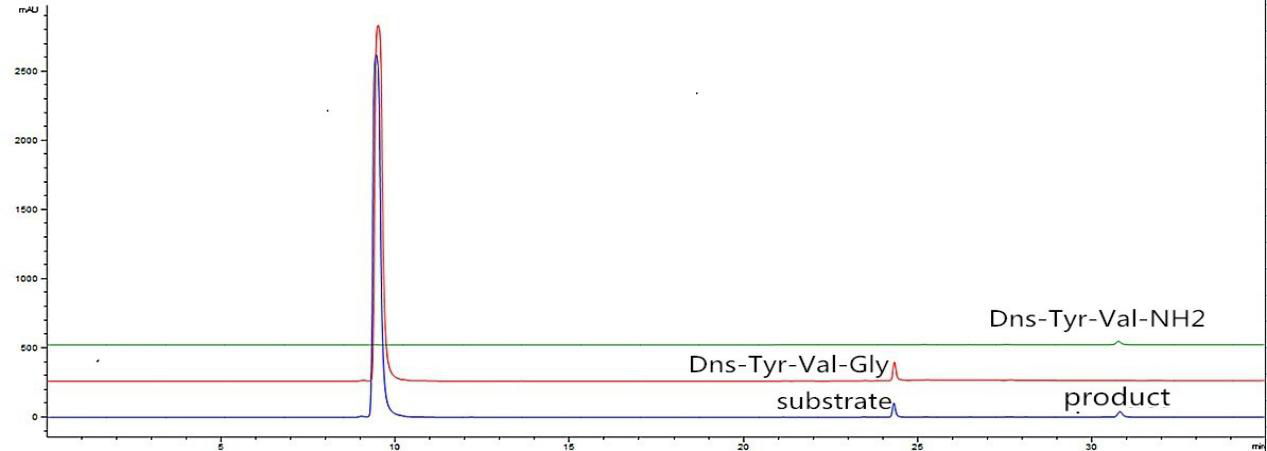
Figure. The reaction product compared with standard Dns-Tyr-Val-Gly and Dns-Tyr-Val-NH2.
As the Figure 1 shows, after 30min later ,the substrate have been hydrolyzed when the PAM was 5ug/mL. The retention time of Dns-Tyr-Val-Gly and Dns-Tyr-Val-NH2 is 24.315 and 30.806 respectively.
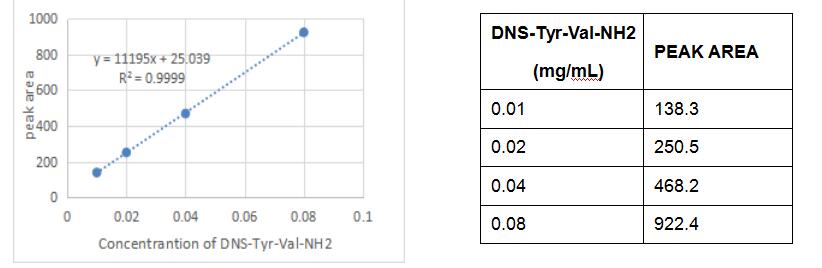
Figure. The sandard curve of Dns-Tyr-Val-NH2.
One unit of enzyme activity is defined as the amount of enzyme required to convert 1μmol of substrate to amidated product in 1min at 37°C. Thus the recombinant rat PAM activity is 2.4×10⁶U.
USAGE
Reconstitute in 10mM PBS (pH7.4) to a concentration of 0.1-1.0 mg/mL. Do not vortex.
STORAGE
Avoid repeated freeze/thaw cycles. Store at 2-8°C for one month. Aliquot and store at -80°C for 12 months.
STABILITY
The thermal stability is described by the loss rate. The loss rate was determined by accelerated thermal degradation test, that is, incubate the protein at 37°C for 48h, and no obvious degradation and precipitation were observed. The loss rate is less than 5% within the expiration date under appropriate storage condition.
| Catalog No. | Related products for research use of Rattus norvegicus (Rat) Organism species | Applications (RESEARCH USE ONLY!) |
| EPC744Ra61 | Eukaryotic Peptidylglycine Alpha Amidating Monooxygenase (PAM) | Positive Control; Immunogen; SDS-PAGE; WB. |
| APC744Ra61 | Active Peptidylglycine Alpha Amidating Monooxygenase (PAM) | Cell culture; Activity Assays. |