

Cloud-clone
SKU:APB243Hu01
Active Heart-type Fatty Acid Binding Protein (H-FABP)
Active Heart-type Fatty Acid Binding Protein (H-FABP)
Couldn't load pickup availability
Product No.
APB243Hu01
Organism Species
Homo sapiens (Human).
Buffer Formulation
20mM Tris, 150mM NaCl, pH8.0, containing 1mM EDTA, 1mM DTT, 0.01% SKL, 5% Trehalose and Proclin300.
Traits
Freeze-dried powder
Purity
> 95%
Isoelectric Point
6.6
Applications
Cell culture; Activity Assays.
UOM
10µg 50µg 200µg 1mg 5mg
ACTIVITY TEST
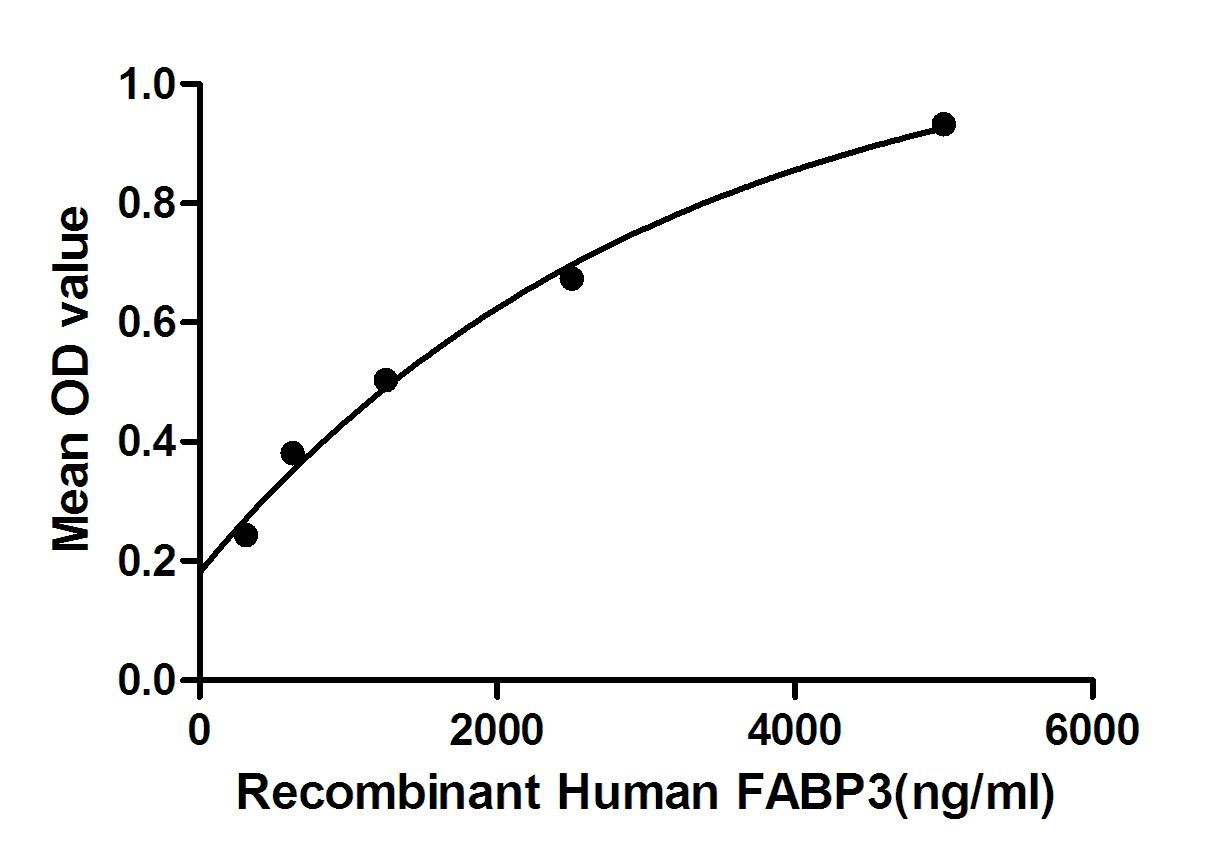
Fatty Acid Binding Protein 3, Muscle And Heart (FABP3) also known as mammary-derived growth inhibitor is a protein that in humans is encoded by the FABP3 gene. FABP3 is a small cytoplasmic protein (15kDa) released from cardiac myocytes following an ischemic episode. It is involved in active fatty acid metabolism where it transports fatty acids from the cell membrane to mitochondria for oxidation. Besides, Fatty Acid Binding Protein 3, Muscle And Heart (FABP3) has been identified as an interactor of SOD1, thus a binding ELISA assay was conducted to detect the interaction of recombinant human FABP3 and recombinant human SOD1. Briefly, FABP3 were diluted serially in PBS, with 0.01% BSA (pH 7.4). Duplicate samples of 100μL were then transferred to SOD1-coated microtiter wells and incubated for 2h at 37℃. Wells were washed with PBST and incubated for 1h with anti-FABP3 pAb, then aspirated and washed 3 times. After incubation with HRP labelled secondary antibody, wells were aspirated and washed 3 times. With the addition of substrate solution, wells were incubated 15-25 minutes at 37℃. Finally, add 50µL stop solution to the wells and read at 450nm immediately. The binding activity of FABP3 and SOD1 was shown in Figure 1, and this effect was in a dose dependent manner.
Figure. The binding activity of FABP3 with SOD1.
USAGE
Reconstitute in 20mM Tris, 150mM NaCl (pH8.0) to a concentration of 0.1-1.0 mg/mL. Do not vortex.
STORAGE
Avoid repeated freeze/thaw cycles. Store at 2-8°C for one month. Aliquot and store at -80°C for 12 months.
STABILITY
The thermal stability is described by the loss rate. The loss rate was determined by accelerated thermal degradation test, that is, incubate the protein at 37°C for 48h, and no obvious degradation and precipitation were observed. The loss rate is less than 5% within the expiration date under appropriate storage condition.
| Magazine | Citations |
| Molecular Medicine Reports | Protective effects of N (2)‑L‑alanyl‑L‑glutamine mediated by the JAK2/STAT3 signaling pathway on myocardial ischemia reperfusion Pubmed:29393473 |
| Oncology Letters | Hydrogen‑rich solution attenuates myocardial injury caused by cardiopulmonary bypass in rats via the Janus‑activated kinase 2/signal transducer and activator of … Pubmed:29928398 |
| FASEB Journal | Signature-oriented investigation of the efficacy of multicomponent drugs against heart failure Pubmed: 30230922 |
