

Cloud-clone
SKU:APB743Hu01
Active Signal Transducer And Activator Of Transcription 3 (STAT3)
Active Signal Transducer And Activator Of Transcription 3 (STAT3)
Couldn't load pickup availability
Product No.
APB743Hu01
Organism Species
Homo sapiens (Human).
Buffer Formulation
20mM Tris, 150mM NaCl, pH8.0, containing 1mM EDTA, 1mM DTT, 0.01% SKL, 5% Trehalose and Proclin300.
Traits
Freeze-dried powder
Purity
> 95%
Isoelectric Point
6.3
Applications
Cell culture; Activity Assays.
UOM
10µg 50µg 200µg 1mg 5mg
ACTIVITY TEST
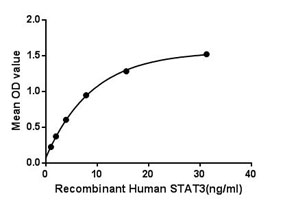
Signal transducer and activator of transcription 3 (STAT3) is a member of the STAT protein family. STAT3 mediates the expression of a variety of genes in response to cell stimuli, and thus plays a key role in many cellular processes such as cell growth and apoptosis. STAT3 is phosphorylated by receptor-associated Janus kinases (JAK), form homo- or heterodimers, and translocate to the cell nucleus where they act as transcription activators. Besides, Epidermal Growth Factor Receptor 2 (EGFR2) has been identified as an interactor of STAT3, thus a binding ELISA assay was conducted to detect the interaction of recombinant human STAT3 and recombinant human EGFR2. Briefly, STAT3 were diluted serially in PBS, with 0.01% BSA (pH 7.4). Duplicate samples of 100µL were then transferred to EGFR2-coated microtiter wells and incubated for 2h at 37℃. Wells were washed with PBST and incubated for 1h with anti-STAT3 pAb, then aspirated and washed 3 times. After incubation with HRP labelled secondary antibody, wells were aspirated and washed 3 times. With the addition of substrate solution, wells were incubated 15-25 minutes at 37℃. Finally, add 50µL stop solution to the wells and read at 450nm immediately. The binding activity of STAT3 and EGFR2 was shown in Figure 1, and this effect was in a dose dependent manner.
Figure. The binding activity of STAT3 with EGFR2
USAGE
Reconstitute in 20mM Tris, 150mM NaCl (pH8.0) to a concentration of 0.1-1.0 mg/mL. Do not vortex.
STORAGE
Avoid repeated freeze/thaw cycles. Store at 2-8°C for one month. Aliquot and store at -80°C for 12 months.
STABILITY
The thermal stability is described by the loss rate. The loss rate was determined by accelerated thermal degradation test, that is, incubate the protein at 37°C for 48h, and no obvious degradation and precipitation were observed. The loss rate is less than 5% within the expiration date under appropriate storage condition.
| Magazine | Citations |
| Pharmaceutics | Oleacein and Foam Cell Formation in Human Monocyte-Derived Macrophages: A Potential Strategy Against Early and Advanced Atherosclerotic Lesions Pubmed: 32283795 |
| CLINICAL IMMUNOLOGY | Serum ERK1/2 proteins fluctuating with HBV infection report frequency of viral-specific CD8+ T cells and predict IFNα therapeutic effect in chronic hepatitis B patients Pubmed: 32791312 |
