FineTest
SKU:FNab00703
anti- ATP5A1 antibody
anti- ATP5A1 antibody
Couldn't load pickup availability
Investigate the role of ATP5A1 in mitochondrial energy synthesis with our Anti-ATP5A1 Antibody, available in a 100µg size. ATP5A1, a crucial subunit of the mitochondrial ATP synthase complex, plays a pivotal role in the production of cellular energy through oxidative phosphorylation.
Derived from rabbit hosts, this polyclonal antibody offers exceptional sensitivity and versatility for a wide range of applications, including Western blotting, immunoprecipitation, and immunofluorescence. Its polyclonal nature allows for recognition of multiple epitopes, enhancing its utility in diverse research contexts.
With 100µg at your disposal, you have a generous supply for multiple experiments, reducing the need for frequent reordering and ensuring the continuity of your research.
Don't miss the opportunity to shed light on the multifaceted functions of ATP5A1 in mitochondrial energy production. With our Anti-ATP5A1 Polyclonal Antibody, you can confidently delve into your research and uncover the secrets hidden within this essential mitochondrial subunit.
Product Name
ATP5A1 antibody
Size
100µg
Form
liquid
Purification
Protein A+G purification
Purity
≥95% as determined by SDS-PAGE
Host
Mouse
Clonality
monoclonal
Isotype
IgG1
Storage
PBS with 0.02% sodium azide and 50% glycerol pH 7.3, -20℃ for 12 months(Avoid repeated freeze / thaw cycles.)
BACKGROUND
Mitochondrial membrane ATP synthase(F(1)F(0) ATP synthase or Complex V) produces ATP from ADP in the presence of a proton gradient across the membrane which is generated by electron transport complexes of the respiratory chain. F-type ATPases consist of two structural domains, F(1)-containing the extramembraneous catalytic core, and F(0)-containing the membrane proton channel, linked together by a central stalk and a peripheral stalk. During catalysis, ATP synthesis in the catalytic domain of F(1) is coupled via a rotary mechanism of the central stalk subunits to proton translocation. Subunits alpha and beta form the catalytic core in F(1). Rotation of the central stalk against the surrounding alpha(3)beta(3) subunits leads to hydrolysis of ATP in three separate catalytic sites on the beta subunits. Subunit alpha does not bear the catalytic high-affinity ATP-binding sites(By similarity).
IMMUNOGEN INFORMATION
Immunogen
ATP synthase, H+ transporting, mitochondrial F1 complex, alpha subunit 1, cardiac muscle
Synonyms
ATP5A, ATP5AL2, ATPM
Observed MW
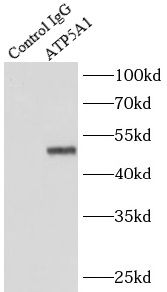
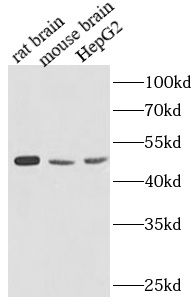
50-55 kDa
APPLICATION
Tested Application
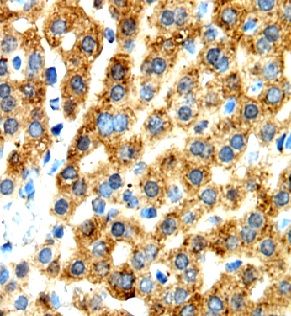
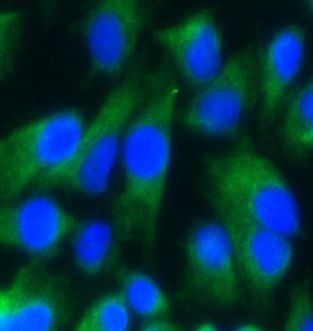
ELISA, IHC, IF, WB, FC
Recommended Dilution
WB: 1:500-1:2000; IP: 1:500-1:1000; IHC: 1:20-1:200; IF: 1:20-1:200
UNIPROT INFORMATION
UniProt ID
IMAGES