FineTest
SKU:FNab00780
anti- BAAT antibody
anti- BAAT antibody
Couldn't load pickup availability
Explore the intricate functions of BAAT with our Anti-BAAT Antibody. This 100µg antibody is your passport to unraveling the mysteries surrounding BAAT, an enzyme crucial for the metabolism of bile acids.
Engineered for accuracy and reliability, this antibody excels in a range of applications, from Western blotting to immunohistochemistry. Its high specificity and sensitivity ensure that your experiments yield accurate and reproducible results, making it an indispensable tool in your laboratory.
BAAT plays a pivotal role in bile acid synthesis and homeostasis, with implications in liver and metabolic diseases. With this antibody in your toolkit, you're better equipped to explore its functions. Whether you're investigating bile acid metabolism or studying liver disorders, this antibody is your trusted research companion.
Invest in scientific excellence by ordering your Anti-BAAT Antibody today and embark on a journey towards a deeper understanding of BAAT biology.
Product Name
BAAT antibody
Size
100µg
Form
liquid
Purification
Immunogen affinity purified
Purity
≥95% as determined by SDS-PAGE
Host
Rabbit
Clonality
polyclonal
Isotype
IgG
Storage
PBS with 0.02% sodium azide and 50% glycerol pH 7.3, -20℃ for 12 months(Avoid repeated freeze / thaw cycles.)
BACKGROUND
Involved in bile acid metabolism. In liver hepatocytes catalyzes the second step in the conjugation of C24 bile acids(choloneates) to glycine and taurine before excretion into bile canaliculi. The major components of bile are cholic acid and chenodeoxycholic acid. In a first step the bile acids are converted to an acyl-CoA thioester, either in peroxisomes(primary bile acids deriving from the cholesterol pathway), or cytoplasmic at the endoplasmic reticulum(secondary bile acids). May catalyze the conjugation of primary or secondary bile acids, or both. The conjugation increases the detergent properties of bile acids in the intestine, which facilitates lipid and fat-soluble vitamin absorption. In turn, bile acids are deconjugated by bacteria in the intestine and are recycled back to the liver for reconjugation(secondary bile acids). May also act as an acyl-CoA thioesterase that regulates intracellular levels of free fatty acids. In vitro, catalyzes the hydrolysis of long-and very long-chain saturated acyl-CoAs to the free fatty acid and coenzyme A(CoASH), and conjugates glycine to these acyl-CoAs.
IMMUNOGEN INFORMATION
Immunogen
bile acid Coenzyme A: amino acid N-acyltransferase(glycine N-choloyltransferase)
Observed MW
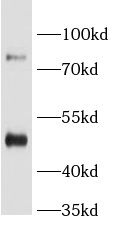
50kd
APPLICATION
Tested Application
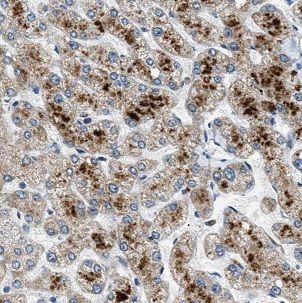
ELISA, WB, IF, IHC
Recommended Dilution
WB: 1:500-1:2000; IHC: 1:20-1:200; IF: 1:20-1:200
UNIPROT INFORMATION
UniProt ID
IMAGES