FineTest
SKU:FNab00807
anti- BATF antibody
anti- BATF antibody
Couldn't load pickup availability
Uncover the multifaceted roles of BATF with our Anti-BATF Antibody. This 100µg antibody is your ticket to deciphering the functions of BATF, a transcription factor involved in immune regulation and cellular differentiation.
Engineered for precision and reliability, this antibody excels in a range of applications, from Western blotting to immunohistochemistry. Its high specificity and sensitivity ensure that your experiments yield accurate and reproducible results, allowing you to advance your research with confidence.
BATF is a central player in immune responses and has implications in various diseases, including cancer and autoimmune disorders. With this antibody in your arsenal, you're better equipped to explore its functions. Whether you're investigating T-cell development or studying immune system dysregulation, this antibody is your trusted research companion.
Elevate your scientific endeavors by ordering your Anti-BATF Antibody today and gain deeper insights into the dynamic world of BATF biology.
Product Name
BATF antibody
Size
100µg
Form
liquid
Purification
Immunogen affinity purified
Purity
≥95% as determined by SDS-PAGE
Host
Rabbit
Clonality
polyclonal
Isotype
IgG
Storage
PBS with 0.02% sodium azide and 50% glycerol pH 7.3, -20℃ for 12 months(Avoid repeated freeze / thaw cycles.)
BACKGROUND
AP-1 family transcription factor that controls the differentiation of lineage-specific cells in the immune system: specifically mediates the differentiation of T-helper 17 cells(Th17), follicular T-helper cells(TfH), CD8(+) dendritic cells and class-switch recombination(CSR) in B-cells. Acts via the formation of a heterodimer with JUNB that recognizes and binds DNA sequence 5'-TGA[CG]TCA-3'. The BATF-JUNB heterodimer also forms a complex with IRF4(or IRF8) in immune cells, leading to recognition of AICE sequence(5'-TGAnTCA/GAAA-3'), an immune-specific regulatory element, followed by cooperative binding of BATF and IRF4(or IRF8) and activation of genes. Controls differentiation of T-helper cells producing interleukin-17(Th17 cells) by binding to Th17-associated gene promoters: regulates expression of the transcription factor RORC itself and RORC target genes such as IL17(IL17A or IL17B). Also involved in differentiation of follicular T-helper cells(TfH) by directing expression of BCL6 and MAF. In B-cells, involved in class-switch recombination(CSR) by controlling the expression of both AICDA and of germline transcripts of the intervening heavy-chain region and constant heavy-chain region(I(H)-C(H)). Following infection, can participate in CD8(+) dendritic cell differentiation via interaction with IRF4 and IRF8 to mediate cooperative gene activation. Regulates effector CD8(+) T-cell differentiation by regulating expression of SIRT1. Following DNA damage, part of a differentiation checkpoint that limits self-renewal of hematopoietic stem cells(HSCs): up-regulated by STAT3, leading to differentiation of HSCs, thereby restricting self-renewal of HSCs(By similarity).
IMMUNOGEN INFORMATION
Immunogen
basic leucine zipper transcription factor, ATF-like
Observed MW
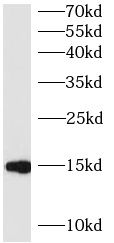
15 kDa
APPLICATION
Tested Application
ELISA, IF, WB
Recommended Dilution
WB: 1:500-1:1000; IF: 1:10-1:100
UNIPROT INFORMATION
UniProt ID
IMAGES