FineTest
SKU:FNab00849
anti- BCL6 antibody
anti- BCL6 antibody
Couldn't load pickup availability
Decipher the functions of BCL6 in lymphocyte regulation with our Anti-BCL6 Antibody. This 100µg antibody is your passport to exploring the roles of BCL6, a key transcription factor involved in B-cell development and immune responses.
Engineered for precision and reliability, this antibody excels in various applications, from chromatin immunoprecipitation to immunofluorescence. Its high specificity and sensitivity ensure that your experiments yield accurate and reproducible results, making it an invaluable tool in your research.
BCL6, also known as B-cell lymphoma 6, is central to B-cell differentiation and has implications in lymphoma and immunology research. With this antibody in your arsenal, you're better equipped to investigate its functions. Whether you're studying B-cell development or its role in lymphoid malignancies, this antibody is your trusted research companion.
Illuminate the path to scientific discovery by ordering your Anti-BCL6 Antibody today and gain deeper insights into the dynamic world of BCL6 biology.
Product Name
BCL6 antibody
Size
100µg
Form
liquid
Purification
Immunogen affinity purified
Purity
≥95% as determined by SDS-PAGE
Host
Rabbit
Clonality
polyclonal
Isotype
IgG
Storage
PBS with 0.02% sodium azide and 50% glycerol pH 7.3, -20℃ for 12 months(Avoid repeated freeze / thaw cycles.)
BACKGROUND
Transcriptional repressor mainly required for germinal center(GC) formation and antibody affinity maturation which has different mechanisms of action specific to the lineage and biological functions. Forms complexes with different corepressors and histone deacetylases to repress the transcriptional expression of different subsets of target genes. Represses its target genes by binding directly to the DNA sequence 5'-TTCCTAGAA-3'(BCL6-binding site) or indirectly by repressing the transcriptional activity of transcription factors. In GC B-cells, represses genes that function in differentiation, inflammation, apoptosis and cell cycle control, also autoregulates its transcriptional expression and up-regulates, indirectly, the expression of some genes important for GC reactions, such as AICDA, through the repression of microRNAs expression, like miR155. An important function is to allow GC B-cells to proliferate very rapidly in response to T-cell dependent antigens and tolerate the physiological DNA breaks required for immunglobulin class switch recombination and somatic hypermutation without inducing a p53/TP53-dependent apoptotic response. In follicular helper CD4(+) T-cells(T(FH) cells), promotes the expression of T(FH)-related genes but inhibits the differentiation of T(H)1, T(H)2 and T(H)17 cells. Also required for the establishment and maintenance of immunological memory for both T-and B-cells. Suppresses macrophage proliferation through competition with STAT5 for STAT-binding motifs binding on certain target genes, such as CCL2 and CCND2. In response to genotoxic stress, controls cell cycle arrest in GC B-cells in both p53/TP53-dependedent and-independent manners. Besides, also controls neurogenesis through the alteration of the composition of NOTCH-dependent transcriptional complexes at selective NOTCH targets, such as HES5, including the recruitment of the deacetylase SIRT1 and resulting in an epigenetic silencing leading to neuronal differentiation.
IMMUNOGEN INFORMATION
Immunogen
B-cell CLL/lymphoma 6
Synonyms
BCL5, LAZ3, ZBTB27, ZNF51
Observed MW
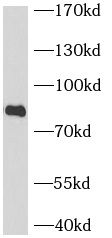
80 kDa
APPLICATION
Tested Application
ELISA, WB
Recommended Dilution
WB: 1:500-1:3000
UNIPROT INFORMATION
UniProt ID
IMAGES