FineTest
SKU:FNab00942
anti- BRCA1 antibody
anti- BRCA1 antibody
Couldn't load pickup availability
Explore the multifunctional roles of BRCA1 (Breast Cancer Susceptibility Gene 1) with our Anti-BRCA1 Antibody, available in a 100µg size. This high-quality antibody is your gateway to investigating the functions and interactions of BRCA1 in DNA repair, genome stability, and breast cancer biology.
Engineered for precision and versatility, this antibody is suitable for applications such as chromatin immunoprecipitation, immunohistochemistry, and co-immunoprecipitation. Whether you're unraveling BRCA1's involvement in homologous recombination, transcriptional regulation, or tumor suppression, this antibody enhances your research capabilities.
BRCA1 is a critical tumor suppressor gene known for its multifaceted roles in DNA repair, cell cycle control, and the maintenance of genomic integrity. Mutations in BRCA1 are linked to hereditary breast and ovarian cancer syndromes.
With our Anti-BRCA1 Antibody, you can explore BRCA1's functionality, investigate its interactions with DNA repair complexes, and potentially advance research in cancer genetics and therapy. Elevate your research in DNA repair mechanisms and hereditary cancer predisposition with this precision antibody.
Product Name
BRCA1 antibody
Size
100µg
Form
liquid
Purification
Immunogen affinity purified
Purity
≥95% as determined by SDS-PAGE
Host
Rabbit
Clonality
polyclonal
Isotype
IgG
Storage
PBS with 0.02% sodium azide and 50% glycerol pH 7.3, -20℃ for 12 months (Avoid repeated freeze / thaw cycles.)
BACKGROUND
This gene encodes a nuclear phosphoprotein that plays a role in maintaining genomic stability, and it also acts as a tumor suppressor. The encoded protein combines with other tumor suppressors, DNA damage sensors, and signal transducers to form a large multi-subunit protein complex known as the BRCA1-associated genome surveillance complex (BASC). This gene product associates with RNA polymerase II, and through the C-terminal domain, also interacts with histone deacetylase complexes. This protein thus plays a role in transcription, DNA repair of double-stranded breaks, and recombination. Mutations in this gene are responsible for approximately 40% of inherited breast cancers and more than 80% of inherited breast and ovarian cancers. Alternative splicing plays a role in modulating the subcellular localization and physiological function of this gene. Many alternatively spliced transcript variants, some of which are disease-associated mutations, have been described for this gene, but the full-length natures of only some of these variants has been described. A related pseudogene, which is also located on chromosome 17, has been identified.
IMMUNOGEN INFORMATION
Immunogen
breast cancer 1, early onset
Synonyms
RNF53
Observed MW
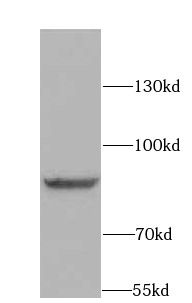
85 kDa
APPLICATION
Tested Application
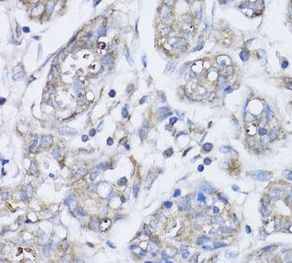
ELISA, WB, IHC, IF
Recommended Dilution
WB: 1:500 - 1:2000; IHC: 1:50 - 1:200; IF: 1:20 - 1:50
UNIPROT INFORMATION
UniProt ID
IMAGES