FineTest
SKU:FNab01564
anti- CDK9 antibody
anti- CDK9 antibody
Couldn't load pickup availability
Uncover the secrets of cellular signaling and transcriptional regulation with our Anti-CDK9 Antibody, now available in a 100µg size. Cyclin-dependent kinase 9 (CDK9) is a central player in the regulation of RNA polymerase II, influencing processes like transcriptional elongation and gene expression. This monoclonal antibody offers remarkable specificity and sensitivity, making it an indispensable tool for researchers investigating cellular signaling, transcriptional control, and the molecular mechanisms governing gene regulation.
With 100µg of this antibody, you'll have a substantial supply for various experiments, ensuring the continuity of your research. Dive into the complexities of CDK9 and its role in transcriptional regulation, its interactions with transcription factors, and its potential implications in gene therapy, cancer research, and targeted therapies.
Product Name
CDK9 antibody
Size
100µg
Form
liquid
Purification
Immunogen affinity purified
Purity
≥95% as determined by SDS-PAGE
Host
Rabbit
Clonality
polyclonal
Isotype
IgG
Storage
PBS with 0.02% sodium azide and 50% glycerol pH 7.3, -20℃ for 12 months(Avoid repeated freeze / thaw cycles.)
BACKGROUND
Protein kinase involved in the regulation of transcription. Member of the cyclin-dependent kinase pair(CDK9/cyclin-T) complex, also called positive transcription elongation factor b(P-TEFb), which facilitates the transition from abortive to productive elongation by phosphorylating the CTD(C-terminal domain) of the large subunit of RNA polymerase II(RNAP II) POLR2A, SUPT5H and RDBP. This complex is inactive when in the 7SK snRNP complex form. Phosphorylates EP300, MYOD1, RPB1/POLR2A and AR, and the negative elongation factors DSIF and NELF. Regulates cytokine inducible transcription networks by facilitating promoter recognition of target transcription factors(e.g. TNF-inducible RELA/p65 activation and IL-6-inducible STAT3 signaling). Promotes RNA synthesis in genetic programs for cell growth, differentiation and viral pathogenesis. P-TEFb is also involved in cotranscriptional histone modification, mRNA processing and mRNA export. Modulates a complex network of chromatin modifications including histone H2B monoubiquitination(H2Bub1), H3 lysine 4 trimethylation(H3K4me3) and H3K36me3; integrates phosphorylation during transcription with chromatin modifications to control co-transcriptional histone mRNA processing. The CDK9/cyclin-K complex has also a kinase activity towards CTD of RNAP II and can substitute for CDK9/cyclin-T P-TEFb in vitro. Replication stress response protein; the CDK9/cyclin-K complex is required for genome integrity maintenance, by promoting cell cycle recovery from replication arrest and limiting single-stranded DNA amount in response to replication stress, thus reducing the breakdown of stalled replication forks and avoiding DNA damage. In addition, probable function in DNA repair of isoform 2 via interaction with KU70/XRCC6. Promotes cardiac myocyte enlargement. RPB1/POLR2A phosphorylation on 'Ser-2' in CTD activates transcription. AR phosphorylation modulates AR transcription factor promoter selectivity and cell growth. DSIF and NELF phosphorylation promotes transcription by inhibiting their negative effect. The phosphorylation of MYOD1 enhances its transcriptional activity and thus promotes muscle differentiation.
IMMUNOGEN INFORMATION
Immunogen
cyclin-dependent kinase 9
Synonyms
CDC2L4, TAK
Observed MW
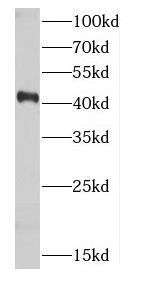
43 kDa
APPLICATION
Tested Application
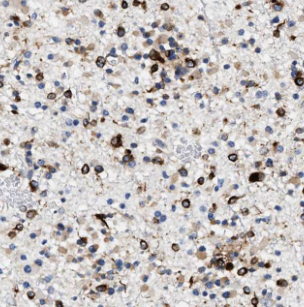
ELISA, WB, IHC
Recommended Dilution
WB: 1:500-1:2000; IHC: 1:20-1:200
UNIPROT INFORMATION
UniProt ID
IMAGES