FineTest
SKU:FNab02073
anti- CUL1 antibody
anti- CUL1 antibody
Couldn't load pickup availability
he anti-CUL1 antibody, available in a 100µg size, is an essential tool for researchers investigating the role of Cullin-1 (CUL1) in cellular processes, particularly in the context of ubiquitin-proteasome system-mediated protein degradation. CUL1 is a key component of the SCF (Skp1-CUL1-F-box protein) E3 ubiquitin ligase complex responsible for tagging specific proteins for degradation.
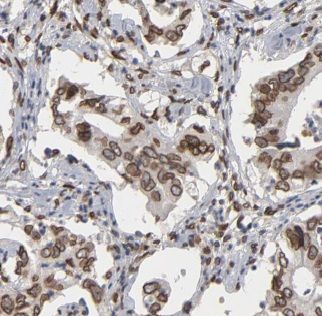
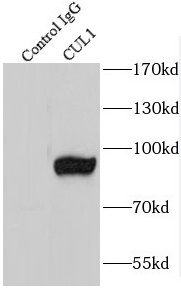
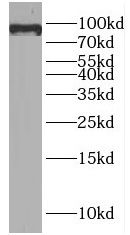
This highly specific polyclonal antibody is meticulously designed to target CUL1 with exceptional sensitivity, making it suitable for various applications, including Western blotting, immunoprecipitation, and immunohistochemistry.
Our anti-CUL1 antibody is sourced from high-quality materials and manufactured under stringent quality control standards, ensuring reliable and reproducible results. It is a trusted choice for researchers exploring the molecular mechanisms of protein turnover, substrate recognition, and cellular homeostasis.
The 100µg size of this antibody provides researchers with an ample supply for multiple experiments and is compatible with various sample types, including cell lysates and tissue sections. Whether investigating protein degradation pathways, protein-protein interactions, or substrate specificity, this antibody is a valuable asset for your research.
Product Name
CUL1 antibody
Size
100µg
Form
liquid
Purification
Immunogen affinity purified
Purity
≥95% as determined by SDS-PAGE
Host
Rabbit
Clonality
polyclonal
Isotype
IgG
Storage
PBS with 0.02% sodium azide and 50% glycerol pH 7.3, -20℃ for 12 months(Avoid repeated freeze / thaw cycles.)
BACKGROUND
Core component of multiple cullin-RING-based SCF(SKP1-CUL1-F-box protein) E3 ubiquitin-protein ligase complexes, which mediate the ubiquitination of proteins involved in cell cycle progression, signal transduction and transcription. In the SCF complex, serves as a rigid scaffold that organizes the SKP1-F-box protein and RBX1 subunits. May contribute to catalysis through positioning of the substrate and the ubiquitin-conjugating enzyme. The E3 ubiquitin-protein ligase activity of the complex is dependent on the neddylation of the cullin subunit and exchange of the substrate recognition component is mediated by TIP120A/CAND1. The functional specificity of the SCF complex depends on the F-box protein as substrate recognition component. SCF(BTRC) and SCF(FBXW11) direct ubiquitination of CTNNB1 and participate in Wnt signaling. SCF(FBXW11) directs ubiquitination of phosphorylated NFKBIA. SCF(BTRC) directs ubiquitination of NFKBIB, NFKBIE, ATF4, SMAD3, SMAD4, CDC25A, FBXO5 and probably NFKB2. SCF(BTRC) and/or SCF(FBXW11) direct ubiquitination of CEP68(PubMed:25704143, PubMed:25503564). SCF(SKP2) directs ubiquitination of phosphorylated CDKN1B/p27kip and is involved in regulation of G1/S transition. SCF(SKP2) directs ubiquitination of ORC1, CDT1, RBL2, ELF4, CDKN1A, RAG2, FOXO1A, and probably MYC and TAL1. SCF(FBXW7) directs ubiquitination of cyclin E, NOTCH1 released notch intracellular domain(NICD), and probably PSEN1. SCF(FBXW2) directs ubiquitination of GCM1. SCF(FBXO32) directs ubiquitination of MYOD1. SCF(FBXO7) directs ubiquitination of BIRC2 and DLGAP5. SCF(FBXO33) directs ubiquitination of YBX1. SCF(FBXO1) directs ubiquitination of BCL6 and DTL but does not seem to direct ubiquitination of TP53. SCF(BTRC) mediates the ubiquitination of NFKBIA at 'Lys-21' and 'Lys-22'; the degradation frees the associated NFKB1-RELA dimer to translocate into the nucleus and to activate transcription. SCF(CCNF) directs ubiquitination of CCP110. SCF(FBXL3) and SCF(FBXL21) direct ubiquitination of CRY1 and CRY2. SCF(FBXO9) directs ubiquitination of TTI1 and TELO2. SCF(FBXO10) directs ubiquitination of BCL2.
IMMUNOGEN INFORMATION
Immunogen
cullin 1
Observed MW
90 kDa
APPLICATION
Tested Application
ELISA, WB, IHC, IP
Recommended Dilution
WB: 1:500-1:2000; IP: 1:200-1:1000; IHC: 1:20-1:200
UNIPROT INFORMATION
UniProt ID
IMAGES