

-
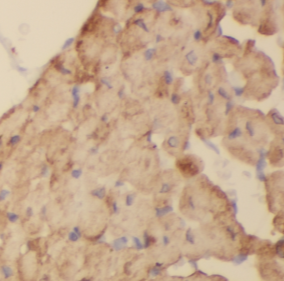 Immunohistochemistry of paraffin-embedded human heart tissue slide using FNab02077(CUL4A Antibody) at dilution of 1:200
 -
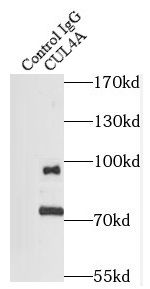 IP Result of anti-CUL4A (IP:FNab02077, 4ug; Detection:FNab02077 1:500) with MCF-7 cells lysate 2800ug.
 -
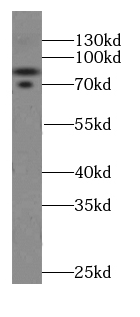 HeLa cells were subjected to SDS PAGE followed by western blot with FNab02077(CUL4A antibody) at dilution of 1:500
1
/
of
1
FineTest
SKU:FNab02077
anti- CUL4A antibody
anti- CUL4A antibody
Regular price
$350.00 USD
Regular price
Sale price
$350.00 USD
Unit price
/
per
Shipping calculated at checkout.
Couldn't load pickup availability
The anti-CUL4A antibody, available in a 100µg size, is a crucial tool for researchers exploring the functions of Cullin-4A (CUL4A) in various cellular processes, particularly its roles in ubiquitin ligase complexes and protein degradation pathways.
This polyclonal antibody is meticulously designed to target CUL4A with exceptional specificity and sensitivity, making it ideal for a wide range of applications, including Western blotting, immunohistochemistry, and co-immunoprecipitation assays.
Our anti-CUL4A antibody is sourced from high-quality materials and undergoes rigorous validation to ensure reliable and reproducible results. It is a trusted choice for researchers investigating the molecular mechanisms of protein turnover, cell cycle regulation, and DNA repair.
The 100µg size of this antibody provides researchers with an ample supply for multiple experiments, and it is compatible with various sample types, including cell lysates and tissue sections. Whether studying cancer biology, DNA damage response, or protein ubiquitination, this antibody is an invaluable resource for your research.
Product Name
CUL4A antibody
Size
100µg
Form
liquid
Purification
Protein A+G purification
Purity
≥95% as determined by SDS-PAGE
Host
Mouse
Clonality
monoclonal
Isotype
IgG1
Storage
PBS with 0.02% sodium azide and 50% glycerol pH 7.3, -20℃ for 12 months(Avoid repeated freeze / thaw cycles.)
BACKGROUND
Core component of multiple cullin-RING-based E3 ubiquitin-protein ligase complexes which mediate the ubiquitination of target proteins. As a scaffold protein may contribute to catalysis through positioning of the substrate and the ubiquitin-conjugating enzyme. The E3 ubiquitin-protein ligase activity of the complex is dependent on the neddylation of the cullin subunit and is inhibited by the association of the deneddylated cullin subunit with TIP120A/CAND1. The functional specificity of the E3 ubiquitin-protein ligase complex depends on the variable substrate recognition component. DCX(DET1-COP1) directs ubiquitination of JUN. DCX(DDB2) directs ubiquitination of XPC. DCX(DDB2) ubiquitinates histones H3-H4 and is required for efficient histone deposition during replication-coupled(H3.1) and replication-independent(H3.3) nucleosome assembly, probably by facilitating the transfer of H3 from ASF1A/ASF1B to other chaperones involved in histone deposition. DCX(DTL) plays a role in PCNA-dependent polyubiquitination of CDT1 and MDM2-dependent ubiquitination of TP53 in response to radiation-induced DNA damage and during DNA replication. In association with DDB1 and SKP2 probably is involved in ubiquitination of CDKN1B/p27kip. Is involved in ubiquitination of HOXA9. DCX(DTL) directs autoubiquitination of DTL.
IMMUNOGEN INFORMATION
Immunogen
cullin 4A
Observed MW
88 kDa, 77 kDa
APPLICATION
Tested Application
ELISA, WB, IHC, IP, IF
Recommended Dilution
WB: 1:500-1:2000; IP: 1:500-1:1000; IHC: 1:20-1:200; IF: 1:20-1:200
UNIPROT INFORMATION
UniProt ID
IMAGES
Share
