FineTest
SKU:FNab02192
anti- Cytohesin 3 antibody
anti- Cytohesin 3 antibody
Couldn't load pickup availability
Our Anti-Cytohesin 3 Antibody, available in a 100µg size, is a valuable tool for researchers investigating the functions and signaling pathways involving cytohesin 3, a guanine nucleotide exchange factor (GEF) known for its role in regulating vesicular trafficking and cell signaling.
Cytohesin 3 plays a crucial role in the activation of ADP-ribosylation factors (ARFs), which are essential for vesicle formation and intracellular transport. Understanding the functions and regulation of cytohesin 3 is key to unraveling its contributions to cellular processes such as receptor recycling, cell adhesion, and membrane dynamics.
This antibody has undergone rigorous validation for specificity and sensitivity, ensuring accurate results in your experiments. Its compact size provides versatility in applications, from studying protein-protein interactions to investigating cytohesin 3's role in intracellular signaling.
Trust in the quality of our Anti-Cytohesin 3 Antibody to advance your research and deepen your understanding of cytohesin 3's role in cellular processes, with potential implications in cell biology and disease mechanisms.
Product Name
Cytokeratin 13 antibody
Size
100µg
Form
liquid
Purification
Immunogen affinity purified
Purity
≥95% as determined by SDS-PAGE
Host
Rabbit
Clonality
polyclonal
Isotype
IgG
Storage
PBS with 0.02% sodium azide and 50% glycerol pH 7.3, -20℃ for 12 months(Avoid repeated freeze / thaw cycles.)
BACKGROUND
The protein encoded by this gene is a member of the keratin gene family. The keratins are intermediate filament proteins responsible for the structural integrity of epithelial cells and are subdivided into cytokeratins and hair keratins. Most of the type I cytokeratins consist of acidic proteins which are arranged in pairs of heterotypic keratin chains. This type I cytokeratin is paired with keratin 4 and expressed in the suprabasal layers of non-cornified stratified epithelia. Mutations in this gene and keratin 4 have been associated with the autosomal dominant disorder White Sponge Nevus. The type I cytokeratins are clustered in a region of chromosome 17q21.2. Alternative splicing of this gene results in multiple transcript variants; however, not all variants have been described.
IMMUNOGEN INFORMATION
Immunogen
keratin 13
Synonyms
CK 13, CK13, Cytokeratin 13, K13, keratin 13, KRT13
Observed MW
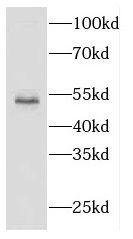
50 kDa
APPLICATION
Tested Application
ELISA, WB
Recommended Dilution
WB: 1:500-1:2000
UNIPROT INFORMATION
UniProt ID
IMAGES