FineTest
SKU:FNab02268
anti- DCLRE1C antibody
anti- DCLRE1C antibody
Couldn't load pickup availability
Our Anti-DCLRE1C (DNA Cross-Link Repair 1C) Antibody, available in a 100µg size, is an essential tool for researchers studying DCLRE1C, a key protein involved in DNA repair and recombination processes. DCLRE1C plays a pivotal role in maintaining genomic stability and preventing DNA damage-induced mutations.
Accurate detection of DCLRE1C is crucial for understanding its functions and its impact on DNA repair pathways and genome integrity. This antibody has undergone rigorous validation for specificity and sensitivity, ensuring reliable results in applications such as immunohistochemistry and chromatin immunoprecipitation.
With its 100µg size, this antibody provides ample material for multiple experiments, allowing you to explore DCLRE1C expression and function in different cell types and DNA repair contexts. Trust in the quality of our Anti-DCLRE1C Antibody to advance your research and deepen your insights into the complex mechanisms of DNA damage repair and genome maintenance.
Product Name
DCLRE1C antibody
Size
100µg
Form
liquid
Purification
Immunogen affinity purified
Purity
≥95% as determined by SDS-PAGE
Host
Rabbit
Clonality
polyclonal
Isotype
IgG
Storage
PBS with 0.02% sodium azide and 50% glycerol pH 7.3, -20℃ for 12 months(Avoid repeated freeze / thaw cycles.)
BACKGROUND
Required for V(D)J recombination, the process by which exons encoding the antigen-binding domains of immunoglobulins and T-cell receptor proteins are assembled from individual V,(D), and J gene segments. V(D)J recombination is initiated by the lymphoid specific RAG endonuclease complex, which generates site specific DNA double strand breaks(DSBs). These DSBs present two types of DNA end structures: hairpin sealed coding ends and phosphorylated blunt signal ends. These ends are independently repaired by the non homologous end joining(NHEJ) pathway to form coding and signal joints respectively. This protein exhibits single-strand specific 5'-3' exonuclease activity in isolation and acquires endonucleolytic activity on 5' and 3' hairpins and overhangs when in a complex with PRKDC. The latter activity is required specifically for the resolution of closed hairpins prior to the formation of the coding joint. May also be required for the repair of complex DSBs induced by ionizing radiation, which require substantial end-processing prior to religation by NHEJ.
IMMUNOGEN INFORMATION
Immunogen
DNA cross-link repair 1C(PSO2 homolog, S. cerevisiae)
Synonyms
ARTEMIS, ASCID, SCIDA, SNM1C
Observed MW
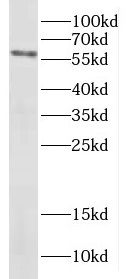
60 kDa
APPLICATION
Tested Application
ELISA, WB
Recommended Dilution
WB: 1:500-1:2000
UNIPROT INFORMATION
UniProt ID
IMAGES