FineTest
SKU:FNab03206
anti- FOXP1 antibody
anti- FOXP1 antibody
Couldn't load pickup availability
Investigate the roles of Forkhead Box P1 (FOXP1) with our Anti-FOXP1 Antibody, available in a 100µg vial. FOXP1 is a transcription factor involved in neural development and essential signaling pathways. This highly specific antibody empowers researchers to explore FOXP1 and its functions, contributing to a deeper understanding of its impact on neurobiology and related research.
Key Features:
- Exceptional Specificity: Our Anti-FOXP1 Antibody is rigorously tested to ensure it accurately targets FOXP1, minimizing the risk of cross-reactivity.
- Versatile Applications: Ideal for various experimental techniques, including immunohistochemistry, Western blotting, and ChIP assays.
- Ample Quantity: With 100µg, you have a generous supply for multiple experiments.
- Top-Tier Quality: Manufactured to the highest industry standards, guaranteeing consistent and reproducible results.
- Advance Your Research: Whether you're studying neural development, FOXP1-associated disorders, or related fields, our Anti-FOXP1 Antibody is your key to investigating FOXP1.
Product Name
FOXP1 antibody
Size
100µg
Form
liquid
Purification
Immunogen affinity purified
Purity
≥95% as determined by SDS-PAGE
Host
Rabbit
Clonality
polyclonal
Isotype
IgG
Storage
PBS with 0.02% sodium azide and 50% glycerol pH 7.3, -20℃ for 12 months(Avoid repeated freeze / thaw cycles.)
BACKGROUND
Transcriptional repressor(PubMed:18347093, PubMed:26647308). Can act with CTBP1 to synergistically repress transcription but CTPBP1 is not essential(By similarity). Plays an important role in the specification and differentiation of lung epithelium. Acts cooperatively with FOXP4 to regulate lung secretory epithelial cell fate and regeneration by restricting the goblet cell lineage program; the function may involve regulation of AGR2. Essential transcriptional regulator of B-cell development. Involved in regulation of cardiac muscle cell proliferation. Involved in the columnar organization of spinal motor neurons. Promotes the formation of the lateral motor neuron column(LMC) and the preganglionic motor column(PGC) and is required for respective appropriate motor axon projections. The segment-appropriate generation of spinal chord motor columns requires cooperation with other Hox proteins. Can regulate PITX3 promoter activity; may promote midbrain identity in embryonic stem cell-derived dopamine neurons by regulating PITX3. Negatively regulates the differentiation of T follicular helper cells T(FH)s. Involved in maintainance of hair follicle stem cell quiescence; the function probably involves regulation of FGF18(By similarity). Represses transcription of various pro-apoptotic genes and cooperates with NF-kappa B-signaling in promoting B-cell expansion by inhibition of caspase-dependent apoptosis(PubMed:25267198). Binds to CSF1R promoter elements and is involved in regulation of monocyte differentiation and macrophage functions; repression of CSF1R in monocytes seems to involve NCOR2 as corepressor(PubMed:15286807, PubMed:18799727, PubMed:18347093). Involved in endothelial cell proliferation, tube formation and migration indicative for a role in angiogenesis; the role in neovascularization seems to implicate suppression of SEMA5B(PubMed:24023716). Can negatively regulate androgen receptor signaling(PubMed:18640093). Isoform 8: Involved in transcriptional regulation in embryonic stem cells(ESCs). Stimulates expression of transcription factors that are required for pluripotency and decreases expression of differentiation-associated genes. Has distinct DNA-binding specifities as compared to the canonical form and preferentially binds DNA with the sequence 5'-CGATACAA-3'(or closely related sequences)(PubMed:21924763). Promotes ESC self-renewal and pluripotency(By similarity).
IMMUNOGEN INFORMATION
Immunogen
forkhead box P1
Observed MW
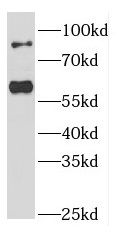
50 kDa, 60-65 kDa, 85 kDa
APPLICATION
Tested Application
ELISA, WB
Recommended Dilution
WB: 1:500-1:2000
UNIPROT INFORMATION
UniProt ID
IMAGES