-
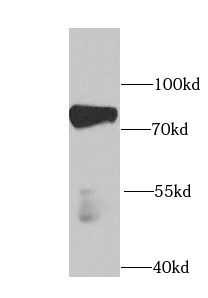
mouse heart tissue were subjected to SDS PAGE followed by western blot with FNab06098(PABPC4 antibody) at dilution of 1:1000
FineTest
SKU:FNab06098
anti- PABPC4 antibody
anti- PABPC4 antibody
Regular price
$290.00 USD
Regular price
Sale price
$290.00 USD
Unit price
per
Shipping calculated at checkout.
Couldn't load pickup availability
PRODUCT INFORMATION
Product Name
PABPC4 antibody
Size
100µg
Form
liquid
Purification
Immunogen affinity purified
Purity
≥95% as determined by SDS-PAGE
Host
Rabbit
Clonality
polyclonal
Isotype
IgG
Storage
PBS with 0.02% sodium azide and 50% glycerol pH 7.3, -20℃ for 12 months (Avoid repeated freeze / thaw cycles.)
BACKGROUND
Poly(A)-binding proteins (PABPs) bind to the poly(A) tail present at the 3-prime ends of most eukaryotic mRNAs. PABPC4 or IPABP (inducible PABP) was isolated as an activation-induced T-cell mRNA encoding a protein. Activation of T cells increased PABPC4 mRNA levels in T cells approximately 5-fold. PABPC4 contains 4 RNA-binding domains and proline-rich C terminus. PABPC4 is localized primarily to the cytoplasm. It is suggested that PABPC4 might be necessary for regulation of stability of labile mRNA species in activated T cells. PABPC4 was also identified as an antigen, APP1 (activated-platelet protein-1), expressed on thrombin-activated rabbit platelets. PABPC4 may also be involved in the regulation of protein translation in platelets and megakaryocytes or may participate in the binding or stabilization of polyadenylates in platelet dense granules. Alternatively spliced transcript variants encoding different isoforms have been found for this gene.
IMMUNOGEN INFORMATION
Immunogen
poly(A) binding protein, cytoplasmic 4 (inducible form)
Synonyms
APP1, PABP4
Observed MW
79 kDa
APPLICATION
Tested Application
ELISA, WB, IHC, IF
Recommended Dilution
WB: 1:500 - 1:2000; IHC: 1:50 - 1:200; IF: 1:10 - 1:100
UNIPROT INFORMATION
UniProt ID
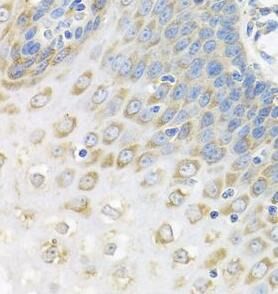
Immunohistochemistry of paraffin-embedded human esophagus using FNab06098(PABPC4 antibody) at dilution of 1:100