FineTest
SKU:FNab09793
anti- FGF2 antibody
anti- FGF2 antibody
Couldn't load pickup availability
Unlock the secrets of fibroblast growth factors with our Anti-FGF2 Antibody, a meticulously crafted product available in a 100µg vial. FGF2, a critical member of the fibroblast growth factor family, is known for its involvement in angiogenesis, wound healing, and tissue regeneration. With this highly specific antibody, you'll gain the ability to investigate the intricate role of FGF2 in various biological contexts and advance your research endeavors with precision and reliability.
Key Features:
- Unparalleled Specificity: Our Anti-FGF2 Antibody is rigorously validated to target FGF2 with high precision, minimizing the risk of cross-reactivity.
- Versatile Applications: Ideal for a wide range of experimental techniques, including immunohistochemistry, ELISA, and immunoprecipitation.
- Ample Quantity: The 100µg quantity provides a substantial reagent supply for numerous experiments.
- Top-Tier Quality: Manufactured to the highest industry standards, ensuring consistency and reproducibility.
- Advance Your Research: Whether you're studying angiogenesis, tissue regeneration, or wound healing, our Anti-FGF2 Antibody is your key to unlocking new knowledge.
Shed light on the intricate role of FGF2 and elevate your research with our Anti-FGF2 Antibody.
Product Name
FGF2 antibody
Size
100µg
Form
liquid
Purification
Immunogen affinity purified
Purity
≥95% as determined by SDS-PAGE
Host
Rabbit
Clonality
polyclonal
Isotype
IgG
Storage
PBS with 0.02% sodium azide and 50% glycerol pH 7.3, -20℃ for 12 months(Avoid repeated freeze / thaw cycles.)
BACKGROUND
The protein encoded by this gene is a member of the fibroblast growth factor (FGF) family. FGF family members bind heparin and possess broad mitogenic and angiogenic activities. This protein has been implicated in diverse biological processes, such as limb and nervous system development, wound healing, and tumor growth. The mRNA for this gene contains multiple polyadenylation sites, and is alternatively translated from non-AUG (CUG) and AUG initiation codons, resulting in five different isoforms with distinct properties. The CUG-initiated isoforms are localized in the nucleus and are responsible for the intracrine effect, whereas, the AUG-initiated form is mostly cytosolic and is responsible for the paracrine and autocrine effects of this FGF.
IMMUNOGEN INFORMATION
Immunogen
FGF2
Synonyms
BFGF, FGF-2, FGFB, HBGF-2
APPLICATION
Tested Application
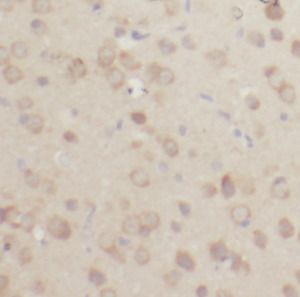
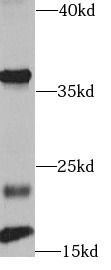
ELISA, WB, IHC
Recommended Dilution
WB: 1:500 - 1:2000; IHC: 1:50 - 1:200
UNIPROT INFORMATION
UniProt ID
IMAGES