FineTest
SKU:FNab10937
anti- CHRNE antibody
anti- CHRNE antibody
Couldn't load pickup availability
Uncover the intricacies of neuromuscular junctions with our Anti-CHRNE Antibody, available in a 100µg size. The cholinergic receptor nicotinic epsilon subunit (CHRNE) is a pivotal component of the neuromuscular junction, essential for muscle contraction and motor control.
This high-quality antibody is meticulously designed to provide exceptional specificity and sensitivity, ensuring accurate detection of CHRNE protein in your experiments. Researchers investigating neuromuscular physiology, motor function, or related fields will appreciate the precision and reliability of this antibody.
Our Anti-CHRNE Antibody undergoes rigorous quality control, guaranteeing consistent and reproducible results. Take your research on neuromuscular transmission and muscle function to the next level with this essential tool.
Product Name
CHRNE antibody
Size
100µg
Form
liquid
Purification
Immunogen affinity purified
Purity
≥95% as determined by SDS-PAGE
Host
Rabbit
Clonality
polyclonal
Isotype
IgG
Storage
PBS with 0.02% sodium azide and 50% glycerol pH 7.3, -20℃ for 12 months(Avoid repeated freeze / thaw cycles.)
BACKGROUND
Acetylcholine receptors at mature mammalian neuromuscular junctions are pentameric protein complexes composed of four subunits in the ratio of two alpha subunits to one beta, one epsilon, and one delta subunit. The acetylcholine receptor changes subunit composition shortly after birth when the epsilon subunit replaces the gamma subunit seen in embryonic receptors. Mutations in the epsilon subunit are associated with congenital myasthenic syndrome.
IMMUNOGEN INFORMATION
Immunogen
Acetylcholine receptor subunit epsilon
Synonyms
CHRNE, ACHRE, CMS1D, CMS1E, CMS2A, CMS4A, CMS4B, CMS4C, FCCMS, SCCMS
Observed MW
45 kDa
APPLICATION
Tested Application
WB
Recommended Dilution
WB: 1:500-1:2000
UNIPROT INFORMATION
UniProt ID
IMAGES
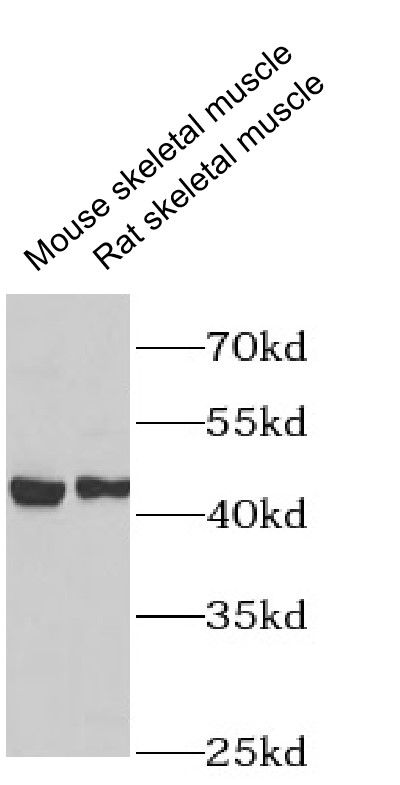
Various lysates were subjected to SDS PAGE followed by western blot with FNab10937( CHRNE Antibody) at dilution of 1:1000.