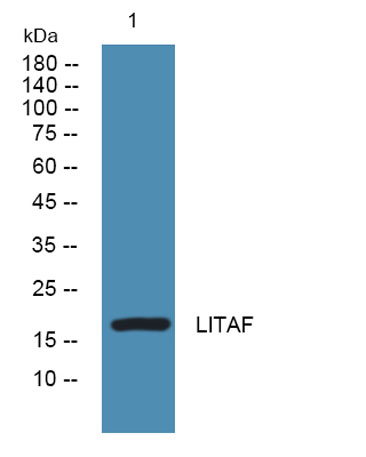
Synthesized peptide derived from part region of human protein
Storage:
Rabbit
Storage:
-20°C/1 year
Clonality:
Polyclonal
Isotype:
IgG
Concentration:
1 mg/ml
Observed Band:
17kD
GeneID(Human):
9516
Human Swiss-Prot No:
Q99732
Cellular localization:
Cytoplasm . Nucleus . Lysosome membrane ; Peripheral membrane protein ; Cytoplasmic side . Early endosome membrane . Late endosome membrane . Endosome membrane ; Peripheral membrane protein ; Cytoplasmic side . Cell membrane ; Peripheral membrane protein ; Cytoplasmic side . Golgi apparatus membrane . Associated with membranes of lysosomes, early and late endosomes (PubMed:11274176, PubMed:27927196, PubMed:27582497). Can translocate from the cytoplasm into the nucleus (PubMed:15793005). Detected at Schmidt-Lanterman incisures and in nodal regions of myelinating Schwann cells (By similarity). .
Background:
Lipopolysaccharide is a potent stimulator of monocytes and macrophages, causing secretion of tumor necrosis factor-alpha (TNF-alpha) and other inflammatory mediators. This gene encodes lipopolysaccharide-induced TNF-alpha factor, which is a DNA-binding protein and can mediate the TNF-alpha expression by direct binding to the promoter region of the TNF-alpha gene. The transcription of this gene is induced by tumor suppressor p53 and has been implicated in the p53-induced apoptotic pathway. Mutations in this gene cause Charcot-Marie-Tooth disease type 1C (CMT1C) and may be involved in the carcinogenesis of extramammary Paget's disease (EMPD). Multiple alternatively spliced transcript variants have been found for this gene. [provided by RefSeq, Dec 2014],