Western Blot: 1/500 - 1/2000. ELISA: 1/20000. Not yet tested in other applications.
Immunogen:
The antiserum was produced against synthesized peptide derived from human CD44 around the phosphorylation site of Ser706. AA range:681-730
Storage:
Rabbit
Storage:
-20°C/1 year
Clonality:
Polyclonal
Isotype:
IgG
Concentration:
1 mg/ml
Observed Band:
90kD
GeneID(Human):
960
Human Swiss-Prot No:
P16070
Cellular localization:
Cell membrane ; Single-pass type I membrane protein . Cell projection, microvillus . Colocalizes with actin in membrane protrusions at wounding edges. Co-localizes with RDX, EZR and MSN in microvilli. Localizes to cholesterol-rich membrane-bound lipid raft domains. .
Background:
The protein encoded by this gene is a cell-surface glycoprotein involved in cell-cell interactions, cell adhesion and migration. It is a receptor for hyaluronic acid (HA) and can also interact with other ligands, such as osteopontin, collagens, and matrix metalloproteinases (MMPs). This protein participates in a wide variety of cellular functions including lymphocyte activation, recirculation and homing, hematopoiesis, and tumor metastasis. Transcripts for this gene undergo complex alternative splicing that results in many functionally distinct isoforms, however, the full length nature of some of these variants has not been determined. Alternative splicing is the basis for the structural and functional diversity of this protein, and may be related to tumor metastasis. [provided by RefSeq, Jul 2008],


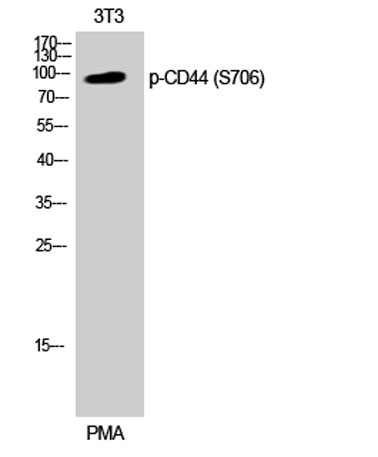 Western Blot analysis of 3T3 cells using Phospho-CD44 (S706) Polyclonal Antibody
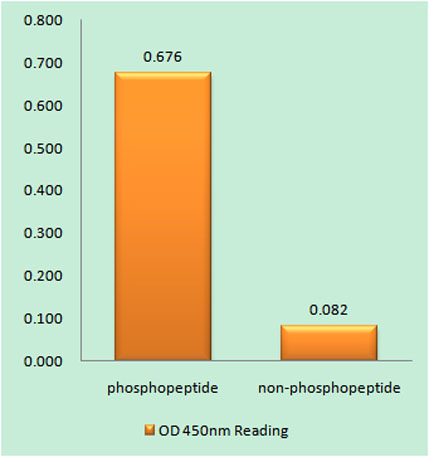 Enzyme-Linked Immunosorbent Assay (Phospho-ELISA) for Immunogen Phosphopeptide (Phospho-left) and Non-Phosphopeptide (Phospho-right), using CD44 (Phospho-Ser706) Antibody
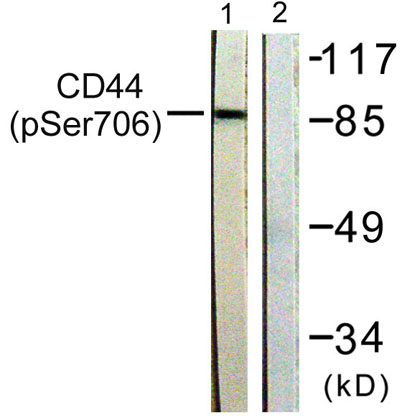 Western blot analysis of lysates from NIH/3T3 cells treated with PMA 250ng/ml 5', using CD44 (Phospho-Ser706) Antibody. The lane on the right is blocked with the phospho peptide.