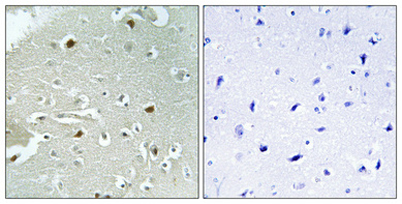
HAND1; BHLHA27; EHAND; Heart- and neural crest derivatives-expressed protein 1; Class A basic helix-loop-helix protein 27; bHLHa27; Extraembryonic tissues; heart, autonomic nervous system and neural crest derivatives-expressed protein 1; eH
Applications:
IHC;IF;ELISA
Recommended Dilutions:
Immunohistochemistry: 1/100 - 1/300. ELISA: 1/10000. Not yet tested in other applications.
Immunogen:
The antiserum was produced against synthesized peptide derived from human HAND1 around the phosphorylation site of Ser98. AA range:71-120
Storage:
Rabbit
Storage:
-20°C/1 year
Clonality:
Polyclonal
Isotype:
IgG
Concentration:
1 mg/ml
GeneID(Human):
9421
Human Swiss-Prot No:
O96004
Cellular localization:
Nucleus, nucleoplasm . Nucleus, nucleolus . Interaction with MDFIC sequesters it into the nucleolus, preventing the transcription factor activity. Phosphorylation by PLK4 disrupts the interaction with MDFIC and releases it from the nucleolus, leading to transcription factor activity (By similarity). .
Background:
The protein encoded by this gene belongs to the basic helix-loop-helix family of transcription factors. This gene product is one of two closely related family members, the HAND proteins, which are asymmetrically expressed in the developing ventricular chambers and play an essential role in cardiac morphogenesis. Working in a complementary fashion, they function in the formation of the right ventricle and aortic arch arteries, implicating them as mediators of congenital heart disease. In addition, it has been suggested that this transcription factor may be required for early trophoblast differentiation. [provided by RefSeq, Jul 2008],