Western Blot: 1/500 - 1/2000. Immunohistochemistry: 1/100 - 1/300. ELISA: 1/40000. Not yet tested in other applications.
Immunogen:
The antiserum was produced against synthesized peptide derived from human BCL10. AA range:111-160
Storage:
Rabbit
Storage:
-20°C/1 year
Clonality:
Polyclonal
Isotype:
IgG
Concentration:
1 mg/ml
Observed Band:
36kD
GeneID(Human):
8915
Human Swiss-Prot No:
O95999
Cellular localization:
Cytoplasm, perinuclear region . Membrane raft . Appears to have a perinuclear, compact and filamentous pattern of expression. Also found in the nucleus of several types of tumor cells. Colocalized with DPP4 in membrane rafts. .
Background:
This gene was identified by its translocation in a case of mucosa-associated lymphoid tissue (MALT) lymphoma. The protein encoded by this gene contains a caspase recruitment domain (CARD), and has been shown to induce apoptosis and to activate NF-kappaB. This protein is reported to interact with other CARD domain containing proteins including CARD9, 10, 11 and 14, which are thought to function as upstream regulators in NF-kappaB signaling. This protein is found to form a complex with MALT1, a protein encoded by another gene known to be translocated in MALT lymphoma. MALT1 and this protein are thought to synergize in the activation of NF-kappaB, and the deregulation of either of them may contribute to the same pathogenetic process that leads to the malignancy. Alternative splicing results in multiple transcript variants. [provided by RefSeq, Mar 2016],


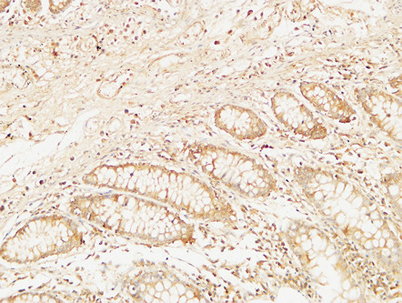 Immunohistochemical analysis of paraffin-embedded Human colon. 1, Antibody was diluted at 1:100(4° overnight). 2, High-pressure and temperature EDTA, pH8.0 was used for antigen retrieval. 3,Secondary antibody was diluted at 1:200(room temperature, 30min)
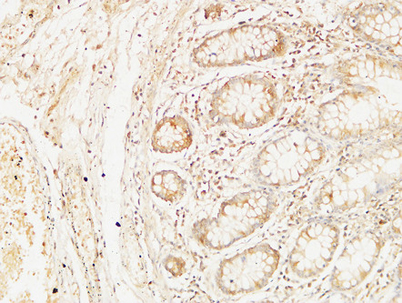 Immunohistochemical analysis of paraffin-embedded Human colon. 1, Antibody was diluted at 1:100(4° overnight). 2, High-pressure and temperature EDTA, pH8.0 was used for antigen retrieval. 3,Secondary antibody was diluted at 1:200(room temperature, 30min)
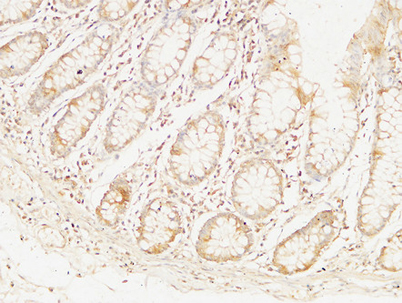 Immunohistochemical analysis of paraffin-embedded Human colon. 1, Antibody was diluted at 1:100(4° overnight). 2, High-pressure and temperature EDTA, pH8.0 was used for antigen retrieval. 3,Secondary antibody was diluted at 1:200(room temperature, 30min)
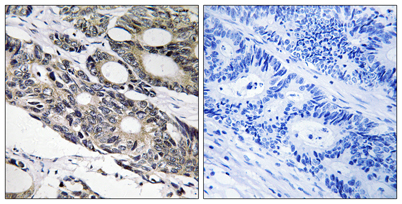 Immunohistochemistry analysis of paraffin-embedded human colon carcinoma tissue, using BCL10 Antibody. The picture on the right is blocked with the synthesized peptide.