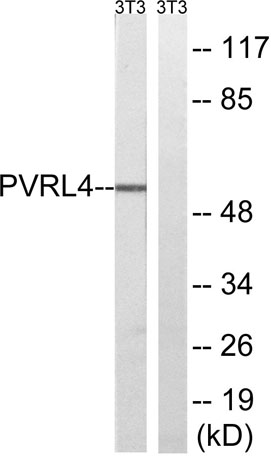
Western Blot: 1/500 - 1/2000. ELISA: 1/5000. Not yet tested in other applications.
Immunogen:
The antiserum was produced against synthesized peptide derived from human PVRL4. AA range:312-361
Storage:
-20°C/1 year
Storage:
Rabbit
Clonality:
Polyclonal
Isotype:
IgG
Concentration:
1 mg/ml
Observed Band:
55kD
GeneID(Human):
81607
Human Swiss-Prot No:
Q96NY8
Cellular localization:
Cell membrane ; Single-pass type I membrane protein . Cell junction, adherens junction . Colocalizes with AFDN at cadherin-based adherens junctions (PubMed:11544254).; [Processed poliovirus receptor-related protein 4]: Secreted . The secreted form is found in breast tumor patients (PubMed:15784625).
Background:
This gene encodes a member of the nectin family. The encoded protein contains two immunoglobulin-like (Ig-like) C2-type domains and one Ig-like V-type domain. It is involved in cell adhesion through trans-homophilic and -heterophilic interactions. It is a single-pass type I membrane protein. The soluble form is produced by proteolytic cleavage at the cell surface by the metalloproteinase ADAM17/TACE. The secreted form is found in both breast tumor cell lines and breast tumor patients. Mutations in this gene are the cause of ectodermal dysplasia-syndactyly syndrome type 1, an autosomal recessive disorder. Alternatively spliced transcript variants have been found but the full-length nature of the variant has not been determined.[provided by RefSeq, Jan 2011],