1
/
of
1
ELK Biotechnology
SKU:ES7407
Troponin I-C Rabbit Polyclonal Antibody
Regular price
$248.00 USD
Regular price
Sale price
$248.00 USD
Unit price
/
per
Shipping calculated at checkout.
Couldn't load pickup availability
Troponin I-C Rabbit Polyclonal Antibody
Overview
| Product name: | Troponin I-C rabbit pAb |
| Alternative Names: | TNNI3; TNNC1; Troponin I; cardiac muscle; Cardiac troponin I |
| Applications: | WB;IHC;IF;ELISA |
| Recommended Dilutions: | Western Blot: 1/500 - 1/2000. Immunohistochemistry: 1/100 - 1/300. Immunofluorescence: 1/200 - 1/1000. ELISA: 1/40000. Not yet tested in other applications. |
| Immunogen: | The antiserum was produced against synthesized peptide derived from human TNNI3. AA range:111-160 |
| Storage: | Rabbit |
| Storage: | -20°C/1 year |
| Clonality: | Polyclonal |
| Isotype: | IgG |
| Concentration: | 1 mg/ml |
| Observed Band: | 28kD |
| GeneID(Human): | 7137 |
| Human Swiss-Prot No: | P19429 |
| Cellular localization: | cytosol,troponin complex,sarcomere, |
| Background: | Troponin I (TnI), along with troponin T (TnT) and troponin C (TnC), is one of 3 subunits that form the troponin complex of the thin filaments of striated muscle. TnI is the inhibitory subunit; blocking actin-myosin interactions and thereby mediating striated muscle relaxation. The TnI subfamily contains three genes: TnI-skeletal-fast-twitch, TnI-skeletal-slow-twitch, and TnI-cardiac. This gene encodes the TnI-cardiac protein and is exclusively expressed in cardiac muscle tissues. Mutations in this gene cause familial hypertrophic cardiomyopathy type 7 (CMH7) and familial restrictive cardiomyopathy (RCM). [provided by RefSeq, Jul 2008], |
| Species Reactivity: | Human;Mouse;Rat |
-
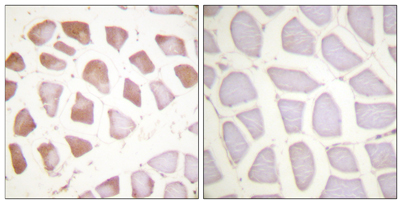
Immunohistochemistry analysis of paraffin-embedded human skeletal muscle tissue, using TNNI3 Antibody. The picture on the right is blocked with the synthesized peptide. -
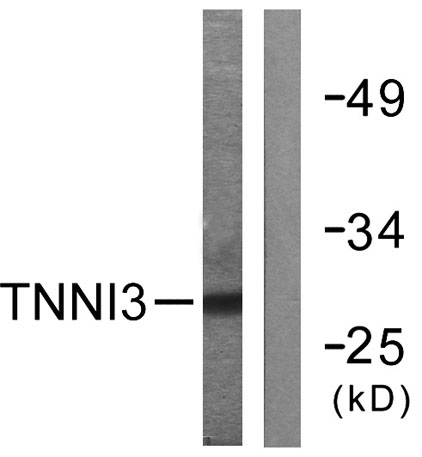
Western blot analysis of lysates from mouse heart cells, using TNNI3 Antibody. The lane on the right is blocked with the synthesized peptide.

Share