WB 1:500-2000 ,Immunohistochemistry: 1/100 - 1/300. ELISA: 1/40000. Not yet tested in other applications.
Immunogen:
The antiserum was produced against synthesized peptide derived from human TIE2 around the phosphorylation site of Tyr1102. AA range:1068-1117
Storage:
Rabbit
Storage:
-20°C/1 year
Clonality:
Polyclonal
Isotype:
IgG
Concentration:
1 mg/ml
GeneID(Human):
7010
Human Swiss-Prot No:
Q02763
Cellular localization:
Cell membrane ; Single-pass type I membrane protein. Cell junction . Cell junction, focal adhesion . Cytoplasm, cytoskeleton. Secreted . Recruited to cell-cell contacts in quiescent endothelial cells (PubMed:18425120, PubMed:18425119). Colocalizes with the actin cytoskeleton and at actin stress fibers during cell spreading. Recruited to the lower surface of migrating cells, especially the rear end of the cell. Proteolytic processing gives rise to a soluble extracellular domain that is secreted (PubMed:11806244). .
Background:
This gene encodes a receptor that belongs to the protein tyrosine kinase Tie2 family. The encoded protein possesses a unique extracellular region that contains two immunoglobulin-like domains, three epidermal growth factor (EGF)-like domains and three fibronectin type III repeats. The ligand angiopoietin-1 binds to this receptor and mediates a signaling pathway that functions in embryonic vascular development. Mutations in this gene are associated with inherited venous malformations of the skin and mucous membranes. Alternative splicing results in multiple transcript variants. Additional alternatively spliced transcript variants of this gene have been described, but their full-length nature is not known. [provided by RefSeq, Feb 2014],


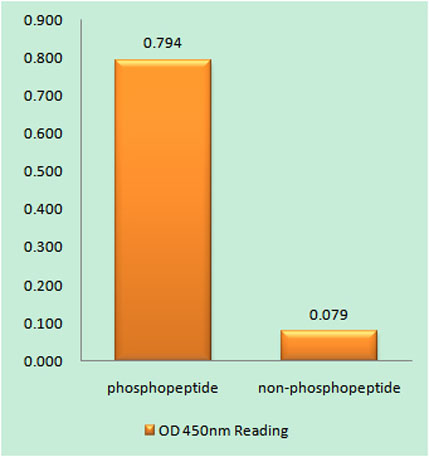 Enzyme-Linked Immunosorbent Assay (Phospho-ELISA) for Immunogen Phosphopeptide (Phospho-left) and Non-Phosphopeptide (Phospho-right), using TIE2 (Phospho-Tyr1102) Antibody
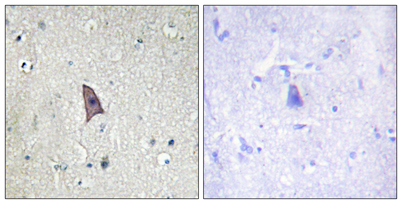 Immunohistochemistry analysis of paraffin-embedded human brain, using TIE2 (Phospho-Tyr1102) Antibody. The picture on the right is blocked with the phospho peptide.