1
/
of
1
ELK Biotechnology
SKU:ES7127
ENaCδ Rabbit Polyclonal Antibody
Regular price
$248.00 USD
Regular price
Sale price
$248.00 USD
Unit price
/
per
Shipping calculated at checkout.
Couldn't load pickup availability
ENaCδ Rabbit Polyclonal Antibody
Overview
| Product name: | ENaCδ rabbit pAb |
| Alternative Names: | SCNN1D; DNACH; Amiloride-sensitive sodium channel subunit delta; Delta-NaCH; Epithelial Na(+) channel subunit delta; Delta-ENaC; ENaCD; Nonvoltage-gated sodium channel 1 subunit delta; SCNED |
| Applications: | WB;IF;ELISA |
| Recommended Dilutions: | Western Blot: 1/500 - 1/2000. Immunofluorescence: 1/200 - 1/1000. ELISA: 1/20000. Not yet tested in other applications. |
| Immunogen: | The antiserum was produced against synthesized peptide derived from human SCNN1D. AA range:411-460 |
| Storage: | Rabbit |
| Storage: | -20°C/1 year |
| Clonality: | Polyclonal |
| Isotype: | IgG |
| Concentration: | 1 mg/ml |
| Observed Band: | 70kD |
| GeneID(Human): | 6339 |
| Human Swiss-Prot No: | P51172 |
| Cellular localization: | Cell membrane ; Multi-pass membrane protein . |
| Background: | function:Sodium permeable non-voltage-sensitive ion channel inhibited by the diuretic amiloride. Mediates the electrodiffusion of the luminal sodium (and water, which follows osmotically) through the apical membrane of epithelial cells. Controls the reabsorption of sodium in kidney, colon, lung and sweat glands. Also plays a role in taste perception.,similarity:Belongs to the amiloride-sensitive sodium channel family.,subunit:Heterotetramer of two alpha, one beta and one gamma subunit. A delta subunit can replace the alpha subunit., |
| Species Reactivity: | Human;Rat;Mouse; |
-
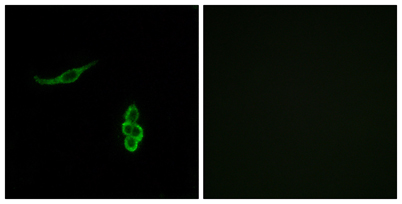
Immunofluorescence analysis of A549 cells, using SCNN1D Antibody. The picture on the right is blocked with the synthesized peptide. -
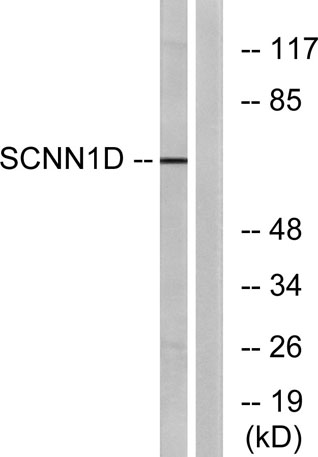
Western blot analysis of lysates from RAW264.7 cells, using SCNN1D Antibody. The lane on the right is blocked with the synthesized peptide. -
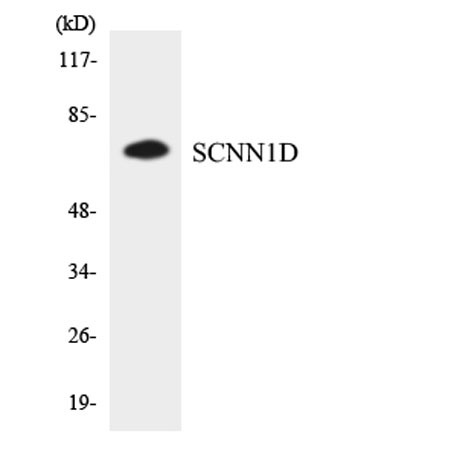
Western blot analysis of the lysates from HT-29 cells using SCNN1D antibody.

Share