Western Blot: 1/500 - 1/2000. Immunohistochemistry: 1/100 - 1/300. ELISA: 1/5000. Not yet tested in other applications.
Immunogen:
The antiserum was produced against synthesized peptide derived from human PKP4. AA range:185-234
Storage:
-20°C/1 year
Storage:
Rabbit
Clonality:
Polyclonal
Isotype:
IgG
Concentration:
1 mg/ml
Observed Band:
130kD
GeneID(Human):
604276
Human Swiss-Prot No:
Q99569
Cellular localization:
Cell junction, desmosome . Cytoplasm, cytoskeleton, spindle . Midbody . Cell membrane ; Peripheral membrane protein . Associated with the pericentrosomal region in interphase and with spindle poles during mitosis. In anaphase, during chromosome segregation, is recruited to the central microtubule bundle, focussed at the spindle midzone and ultimately localizes to the midbody at cytokinesis. Constituent of the midbody cytoskeletal matrix. Colocalized with desmoplakin at desmosomal junctional plaques in cultured epithelial cells.
Background:
Armadillo-like proteins are characterized by a series of armadillo repeats, first defined in the Drosophila 'armadillo' gene product, that are typically 42 to 45 amino acids in length. These proteins can be divided into subfamilies based on their number of repeats, their overall sequence similarity, and the dispersion of the repeats throughout their sequences. Members of the p120(ctn)/plakophilin subfamily of Armadillo-like proteins, including CTNND1, CTNND2, PKP1, PKP2, PKP4, and ARVCF. PKP4 may be a component of desmosomal plaque and other adhesion plaques and is thought to be involved in regulating junctional plaque organization and cadherin function. Multiple transcript variants encoding different isoforms have been found for this gene. [provided by RefSeq, Feb 2015],


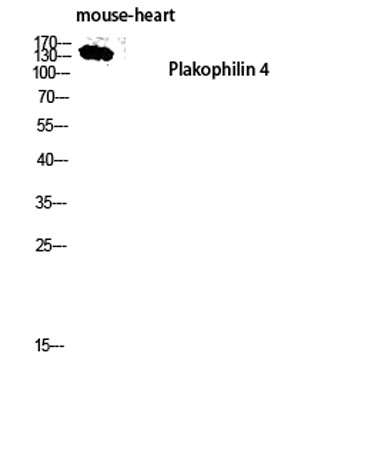 Western blot analysis of mouse-heart lysis using Plakophilin 4 antibody. Antibody was diluted at 1:2000
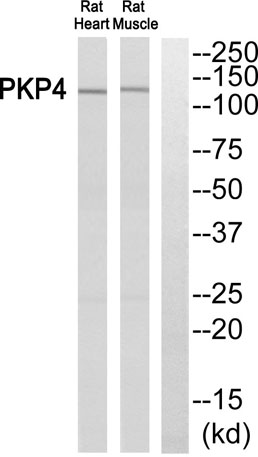 Western blot analysis of PKP4 Antibody. The lane on the right is blocked with the PKP4 peptide.
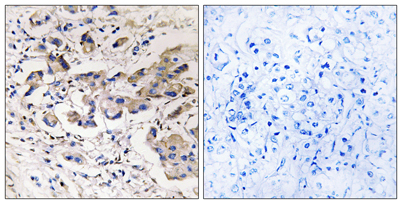 Immunohistochemistryt analysis of paraffin-embedded human breast carcinoma, using PKP4 Antibody. The lane on the right is blocked with the PKP4 peptide.