| Background: |
caution:Was originally (PubMed:1577270) thought to inhibit the transcriptional activity of nuclear factor NF-kappa-B.,domain:Both N- and C-terminal domains are required for transcriptional activation.,function:NF-kappa-B is a pleiotropic transcription factor which is present in almost all cell types and is involved in many biological processed such as inflammation, immunity, differentiation, cell growth, tumorigenesis and apoptosis. NF-kappa-B is a homo- or heterodimeric complex formed by the Rel-like domain-containing proteins RELA/p65, RELB, NFKB1/p105, NFKB1/p50, REL and NFKB2/p52. The dimers bind at kappa-B sites in the DNA of their target genes and the individual dimers have distinct preferences for different kappa-B sites that they can bind with distinguishable affinity and specificity. Different dimer combinations act as transcriptional activators or repressors, respectively. NF-kappa-B is controlled by various mechanisms of post-translational modification and subcellular compartmentalization as well as by interactions with other cofactors or corepressors. NF-kappa-B complexes are held in the cytoplasm in an inactive state complexed with members of the NF-kappa-B inhibitor (I-kappa-B) family. In a conventional activation pathway, I-kappa-B is phosphorylated by I-kappa-B kinases (IKKs) in response to different activators, subsequently degraded thus liberating the active NF-kappa-B complex which translocates to the nucleus. NF-kappa-B heterodimeric RelB-p50 and RelB-p52 complexes are transcriptional activators. RELB neither associates with DNA nor with RELA/p65 or REL. Stimulates promoter activity in the presence of NFKB2/p49.,induction:By mitogens.,PTM:Phosphorylation at 'Thr-103' and 'Ser-573' is followed by proteasomal degradation.,similarity:Contains 1 RHD (Rel-like) domain.,subunit:Component of the NF-kappa-B RelB-p50 complex. Component of the NF-kappa-B RelB-p52 complex. Self-associates; the interaction seems to be transient and may prevent degradation allowing for heterodimer formation with p50 or p52. Interacts with NFKB1/p50, NFKB2/p52 and NFKB2/p100. Interacts with NFKBID., |


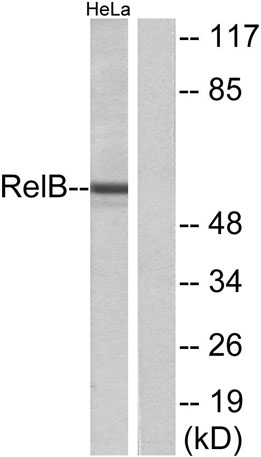 Western blot analysis of lysates from HeLa cells, using RelB Antibody. The lane on the right is blocked with the synthesized peptide.
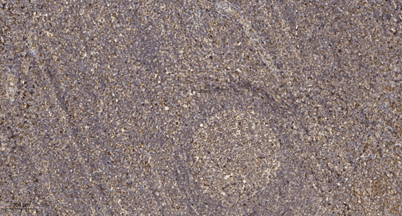 Immunohistochemical analysis of paraffin-embedded human tonsil. 1, Antibody was diluted at 1:200(4° overnight). 2, Tris-EDTA,pH9.0 was used for antigen retrieval. 3,Secondary antibody was diluted at 1:200(room temperature, 45min).