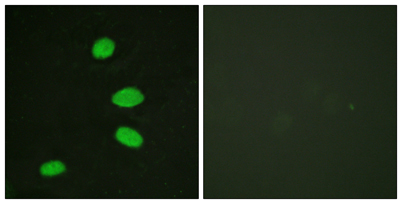
| Background: |
function:Key regulator of entry into cell division. Directly involved in heterochromatin formation by maintaining overall chromatin structure and, in particular, that of constitutive heterochromatin by stabilizing histone methylation. Recruits and targets histone methyltransferases SUV420H1 and SUV420H2, leading to epigenetic transcriptional repression. Controls histone H4 'Lys-20' trimethylation. Probably acts as a transcription repressor by recruiting chromatin-modifying enzymes to promoters. Potent inhibitor of E2F-mediated trans-activation, associates preferentially with E2F5. Binds to cyclins A and E. Binds to and may be involved in the transforming capacity of the adenovirus E1A protein. May act as a tumor suppressor.,miscellaneous:G0-restricted expression.,PTM:During G0 and early G1 phase of the cell cycle, phosphorylated on Ser-639 and on 5 sites within the domain B. Phosphorylation on Ser-672 in G1 leads to its ubiquitin-dependent proteolysis.,similarity:Belongs to the retinoblastoma protein (RB) family.,subunit:Interacts with AATF. Interacts with SUV420H1 and SUV420H2 (By similarity). Component of the DREAM complex (also named LINC complex) at least composed of E2F4, E2F5, LIN9, LIN37, LIN52, LIN54, MYBL1, MYBL2, RBL1, RBL2, RBBP4, TFDP1 and TFDP2. The complex exists in quiescent cells where it represses cell cycle-dependent genes. It dissociates in S phase when LIN9, LIN37, LIN52 and LIN54 form a subcomplex that binds to MYBL2. Interacts with RINT1., |