WB 1:500-2000 Immunohistochemistry: 1/100 - 1/300. ELISA: 1/5000. Not yet tested in other applications.
Immunogen:
The antiserum was produced against synthesized peptide derived from human SPHK2 around the phosphorylation site of Thr614. AA range:580-629
Storage:
Rabbit
Storage:
-20°C/1 year
Clonality:
Polyclonal
Isotype:
IgG
Concentration:
1 mg/ml
GeneID(Human):
56848
Human Swiss-Prot No:
Q9NRA0
Cellular localization:
Cytoplasm . Nucleus . Endoplasmic reticulum . Mitochondrion inner membrane . In nucleus, located in nucleosomes where it associates with core histone proteins such as histone 3 (PubMed:19729656). In brains of patients with Alzheimer's disease, may be preferentially localized in the nucleus. Cytosolic expression decrease correlates with the density of amyloid deposits (PubMed:29615132). In apoptotic cells, colocalizes with CASP1 in cell membrane where is cleaved and released from cells in an active form (PubMed:20197547). .; [Isoform 2]: Lysosome membrane .
Background:
This gene encodes one of two sphingosine kinase isozymes that catalyze the phosphorylation of sphingosine into sphingosine 1-phosphate. Sphingosine 1-phosphate mediates many cellular processes including migration, proliferation and apoptosis, and also plays a role in several types of cancer by promoting angiogenesis and tumorigenesis. The encoded protein may play a role in breast cancer proliferation and chemoresistance. Alternatively spliced transcript variants encoding multiple isoforms have been observed for this gene. [provided by RefSeq, Aug 2011],


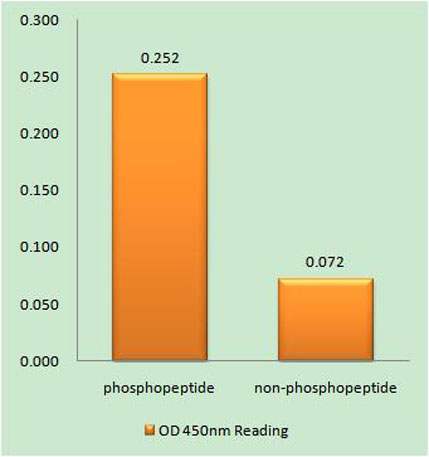 Enzyme-Linked Immunosorbent Assay (Phospho-ELISA) for Immunogen Phosphopeptide (Phospho-left) and Non-Phosphopeptide (Phospho-right), using SPHK2 (Phospho-Thr614) Antibody
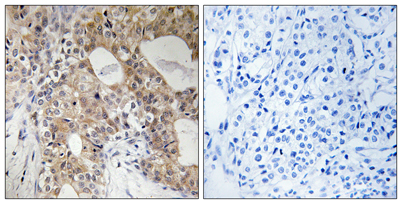 Immunohistochemistry analysis of paraffin-embedded human breast carcinoma, using SPHK2 (Phospho-Thr614) Antibody. The picture on the right is blocked with the phospho peptide.