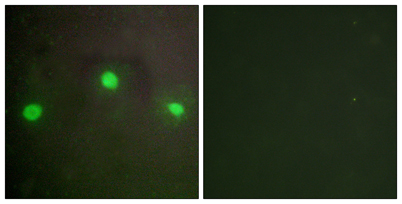
Immunofluorescence: 1/200 - 1/1000. ELISA: 1/10000. Not yet tested in other applications.
Immunogen:
The antiserum was produced against synthesized peptide derived from human ATRX. AA range:111-160
Storage:
Rabbit
Storage:
-20°C/1 year
Clonality:
Polyclonal
Isotype:
IgG
Concentration:
1 mg/ml
GeneID(Human):
546
Human Swiss-Prot No:
P46100
Cellular localization:
Nucleus. Chromosome, telomere. Nucleus, PML body. Associated with pericentromeric heterochromatin during interphase and mitosis, probably by interacting with CBX5/HP1 alpha. Colocalizes with histone H3.3, DAXX, HIRA and ASF1A at PML-nuclear bodies. Colocalizes with cohesin (SMC1 and SMC3) and MECP2 at the maternal H19 ICR (By similarity). .
Background:
ATRX, chromatin remodeler(ATRX) Homo sapiens The protein encoded by this gene contains an ATPase/helicase domain, and thus it belongs to the SWI/SNF family of chromatin remodeling proteins. This protein is found to undergo cell cycle-dependent phosphorylation, which regulates its nuclear matrix and chromatin association, and suggests its involvement in the gene regulation at interphase and chromosomal segregation in mitosis. Mutations in this gene are associated with an X-linked mental retardation (XLMR) syndrome most often accompanied by alpha-thalassemia (ATRX) syndrome. These mutations have been shown to cause diverse changes in the pattern of DNA methylation, which may provide a link between chromatin remodeling, DNA methylation, and gene expression in developmental processes. Multiple alternatively spliced transcript variants encoding distinct isoforms have been reported. [provided by RefSeq, Aug 2013],