Western Blot: 1/500 - 1/2000. Immunohistochemistry: 1/100 - 1/300. Immunofluorescence: 1/200 - 1/1000. ELISA: 1/40000. Not yet tested in other applications.
Immunogen:
The antiserum was produced against synthesized peptide derived from human LAMA3. AA range:2571-2620
Storage:
Rabbit
Storage:
-20°C/1 year
Clonality:
Polyclonal
Isotype:
IgG
Concentration:
1 mg/ml
Observed Band:
120 60kD
GeneID(Human):
3909
Human Swiss-Prot No:
Q16787
Cellular localization:
Secreted, extracellular space, extracellular matrix, basement membrane. Major component.
Background:
The protein encoded by this gene belongs to the laminin family of secreted molecules. Laminins are heterotrimeric molecules that consist of alpha, beta, and gamma subunits that assemble through a coiled-coil domain. Laminins are essential for formation and function of the basement membrane and have additional functions in regulating cell migration and mechanical signal transduction. This gene encodes an alpha subunit and is responsive to several epithelial-mesenchymal regulators including keratinocyte growth factor, epidermal growth factor and insulin-like growth factor. Mutations in this gene have been identified as the cause of Herlitz type junctional epidermolysis bullosa and laryngoonychocutaneous syndrome. Alternative splicing and alternative promoter usage result in multiple transcript variants. [provided by RefSeq, Dec 2014],


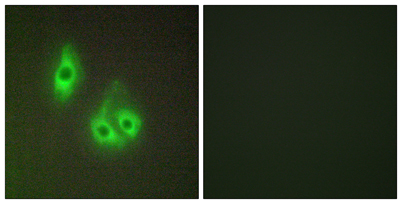 Immunofluorescence analysis of HepG2 cells, using LAMA3 Antibody. The picture on the right is blocked with the synthesized peptide.
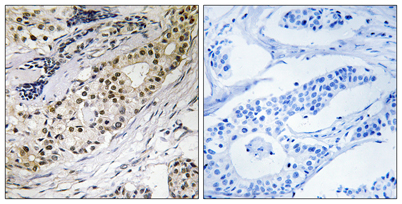 Immunohistochemistry analysis of paraffin-embedded human colon carcinoma tissue, using LAMA3 Antibody. The picture on the right is blocked with the synthesized peptide.
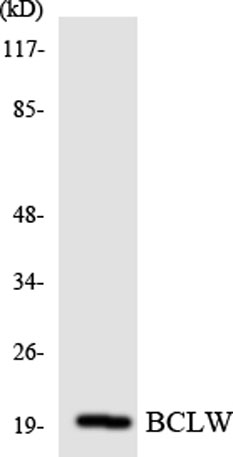 Western blot analysis of the lysates from HeLa cells using BCLW antibody.