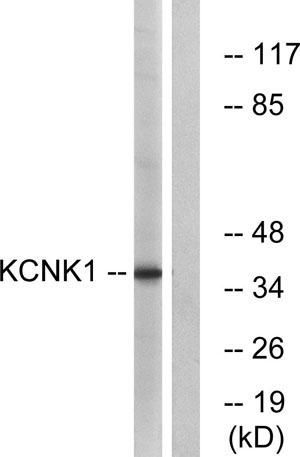
KCNK1; HOHO1; KCNO1; TWIK1; Potassium channel subfamily K member 1; Inward rectifying potassium channel protein TWIK-1; Potassium channel KCNO1
Applications:
WB;ELISA
Recommended Dilutions:
Western Blot: 1/500 - 1/2000. ELISA: 1/40000. Not yet tested in other applications.
Immunogen:
The antiserum was produced against synthesized peptide derived from human KCNK1. AA range:287-336
Storage:
Rabbit
Storage:
-20°C/1 year
Clonality:
Polyclonal
Isotype:
IgG
Concentration:
1 mg/ml
Observed Band:
38kD
GeneID(Human):
3775
Human Swiss-Prot No:
O00180
Cellular localization:
Cell membrane ; Multi-pass membrane protein . Recycling endosome . Cell junction, synapse, synaptic cell membrane . Cytoplasmic vesicle . Perikaryon . Cell projection, dendrite . Cell projection . Apical cell membrane ; Multi-pass membrane protein . The heterodimer with KCNK2 is detected at the astrocyte cell membrane. Not detected at the astrocyte cell membrane when KCNK2 is absent. Detected on neuronal cell bodies, and to a lesser degree on neuronal cell projections. Detected on hippocampus dentate gyrus granule cell bodies and to a lesser degree on proximal dendrites. Detected at the apical cell membrane in stria vascularis in the cochlea. Detected at the apical cell membrane of vestibular dark cells situated between the crista and the utricle in the inner ear. Detected at the apical ce
Background:
This gene encodes one of the members of the superfamily of potassium channel proteins containing two pore-forming P domains. The product of this gene has not been shown to be a functional channel, however, it may require other non-pore-forming proteins for activity. [provided by RefSeq, Jul 2008],