

ELK Biotechnology
SKU:ES5652
NMDAε1/2 (phospho Tyr1246/1252) Rabbit Polyclonal Antibody
NMDAε1/2 (phospho Tyr1246/1252) Rabbit Polyclonal Antibody
Regular price
$248.00 USD
Regular price
Sale price
$248.00 USD
Unit price
per
Shipping calculated at checkout.
Couldn't load pickup availability
NMDAε1/2 (phospho Tyr1246/1252) Rabbit Polyclonal Antibody
Overview
-
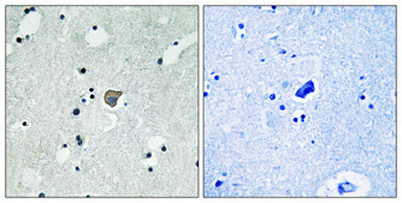 Immunohistochemical analysis of paraffin-embedded Human brain. Antibody was diluted at 1:100(4° overnight). High-pressure and temperature Tris-EDTA,pH8.0 was used for antigen retrieval. Negetive contrl (right) obtaned from antibody was pre-absorbed by i
 -
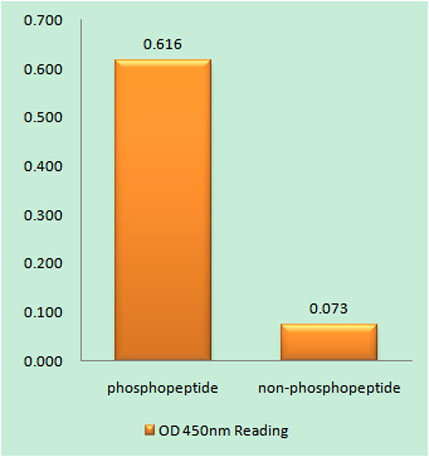 Enzyme-Linked Immunosorbent Assay (Phospho-ELISA) for Immunogen Phosphopeptide (Phospho-left) and Non-Phosphopeptide (Phospho-right), using NMDAR2A/B (Phospho-Tyr1246/1252) Antibody
 -
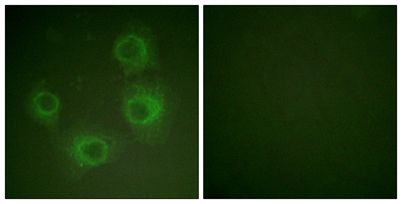 Immunofluorescence analysis of HUVEC cells, using NMDAR2A/B (Phospho-Tyr1246/1252) Antibody. The picture on the right is blocked with the phospho peptide.
 -
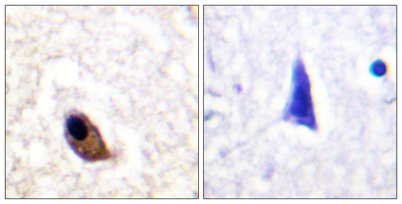 Immunohistochemistry analysis of paraffin-embedded human brain, using NMDAR2A/B (Phospho-Tyr1246/1252) Antibody. The picture on the right is blocked with the phospho peptide.
