CBX5; HP1A; Chromobox protein homolog 5; Antigen p25; Heterochromatin protein 1 homolog alpha; HP1 alpha
Applications:
IHC;IF;ELISA
Recommended Dilutions:
Immunohistochemistry: 1/100 - 1/300. ELISA: 1/40000. Not yet tested in other applications.
Immunogen:
The antiserum was produced against synthesized peptide derived from human HP1 alpha around the phosphorylation site of Ser92. AA range:58-107
Storage:
Rabbit
Storage:
-20°C/1 year
Clonality:
Polyclonal
Isotype:
IgG
Concentration:
1 mg/ml
GeneID(Human):
23468
Human Swiss-Prot No:
P45973
Cellular localization:
Nucleus . Chromosome . Chromosome, centromere . Colocalizes with HNRNPU in the nucleus (PubMed:19617346). Component of centromeric and pericentromeric heterochromatin. Associates with chromosomes during mitosis. Associates specifically with chromatin during metaphase and anaphase. .
Background:
This gene encodes a highly conserved nonhistone protein, which is a member of the heterochromatin protein family. The protein is enriched in the heterochromatin and associated with centromeres. The protein has a single N-terminal chromodomain which can bind to histone proteins via methylated lysine residues, and a C-terminal chromo shadow-domain (CSD) which is responsible for the homodimerization and interaction with a number of chromatin-associated nonhistone proteins. The encoded product is involved in the formation of functional kinetochore through interaction with essential kinetochore proteins. The gene has a pseudogene located on chromosome 3. Multiple alternatively spliced variants, encoding the same protein, have been identified. [provided by RefSeq, Jul 2008],


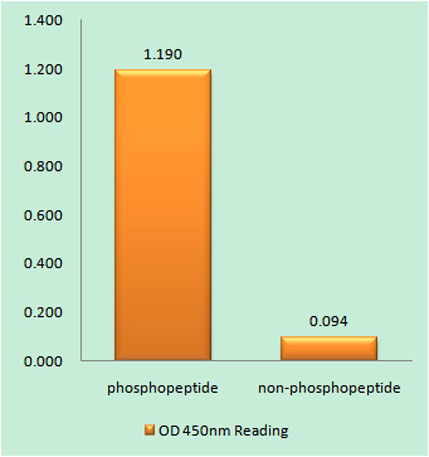 Enzyme-Linked Immunosorbent Assay (Phospho-ELISA) for Immunogen Phosphopeptide (Phospho-left) and Non-Phosphopeptide (Phospho-right), using HP1 alpha (Phospho-Ser92) Antibody
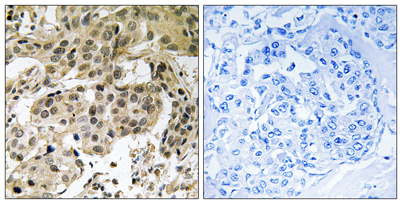 Immunohistochemistry analysis of paraffin-embedded human breast carcinoma, using HP1 alpha (Phospho-Ser92) Antibody. The picture on the right is blocked with the phospho peptide.