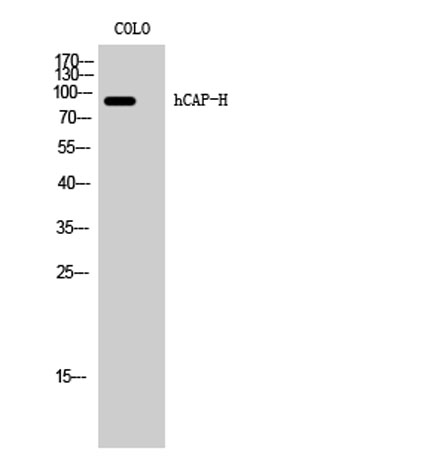
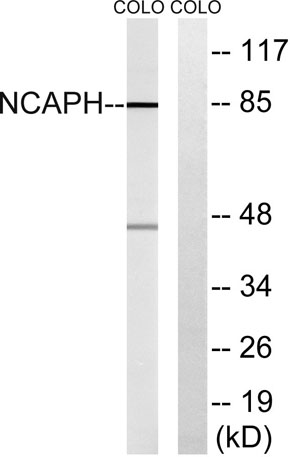
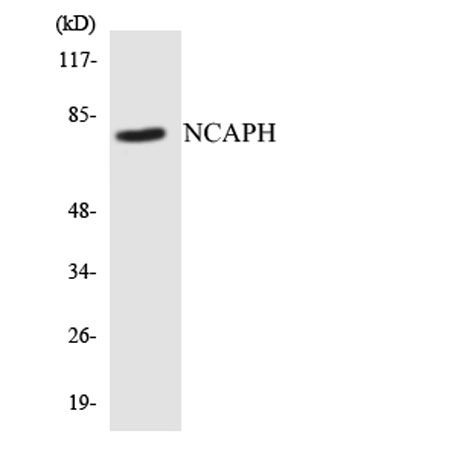
NCAPH; BRRN; BRRN1; CAPH; KIAA0074; Condensin complex subunit 2; Barren homolog protein 1; Chromosome-associated protein H; hCAP-H; Non-SMC condensin I complex subunit H; XCAP-H homolog
Applications:
WB;ELISA
Recommended Dilutions:
Western Blot: 1/500 - 1/2000. ELISA: 1/40000. Not yet tested in other applications.
Immunogen:
The antiserum was produced against synthesized peptide derived from human NCAPH. AA range:441-490
Storage:
Rabbit
Storage:
-20°C/1 year
Clonality:
Polyclonal
Isotype:
IgG
Concentration:
1 mg/ml
Observed Band:
83kD
GeneID(Human):
23397
Human Swiss-Prot No:
Q15003
Cellular localization:
Nucleus . Cytoplasm . Chromosome . In interphase cells, the majority of the condensin complex is found in the cytoplasm, while a minority of the complex is associated with chromatin. A subpopulation of the complex however remains associated with chromosome foci in interphase cells. During mitosis, most of the condensin complex is associated with the chromatin. At the onset of prophase, the regulatory subunits of the complex are phosphorylated by CDK1, leading to condensin's association with chromosome arms and to chromosome condensation. Dissociation from chromosomes is observed in late telophase.
Background:
This gene encodes a member of the barr gene family and a regulatory subunit of the condensin complex. This complex is required for the conversion of interphase chromatin into condensed chromosomes. The protein encoded by this gene is associated with mitotic chromosomes, except during the early phase of chromosome condensation. During interphase, the protein has a distinct punctate nucleolar localization. Alternatively spliced transcript variants encoding different proteins have been described. [provided by RefSeq, Jul 2013],