Western Blot: 1/500 - 1/2000. Immunohistochemistry: 1/100 - 1/300. ELISA: 1/20000. Not yet tested in other applications.
Immunogen:
The antiserum was produced against synthesized peptide derived from human ATG4B. AA range:71-120
Storage:
Rabbit
Storage:
-20°C/1 year
Clonality:
Polyclonal
Isotype:
IgG
Concentration:
1 mg/ml
Observed Band:
44kD
GeneID(Human):
23192
Human Swiss-Prot No:
Q9Y4P1
Cellular localization:
Cytoplasm . Cytoplasm, cytosol . Cytoplasmic vesicle, autophagosome . Endoplasmic reticulum . Mitochondrion . Mainly localizes to the cytoplasm, including cytosol (PubMed:29165041). A samll potion localizes to mitochondria; phosphorylation at Ser-34 promotes localization to mitochondria (PubMed:29165041). .
Background:
Autophagy is the process by which endogenous proteins and damaged organelles are destroyed intracellularly. Autophagy is postulated to be essential for cell homeostasis and cell remodeling during differentiation, metamorphosis, non-apoptotic cell death, and aging. Reduced levels of autophagy have been described in some malignant tumors, and a role for autophagy in controlling the unregulated cell growth linked to cancer has been proposed. This gene encodes a member of the autophagin protein family. The encoded protein is also designated as a member of the C-54 family of cysteine proteases. Alternate transcriptional splice variants, encoding different isoforms, have been characterized. [provided by RefSeq, Jul 2008],


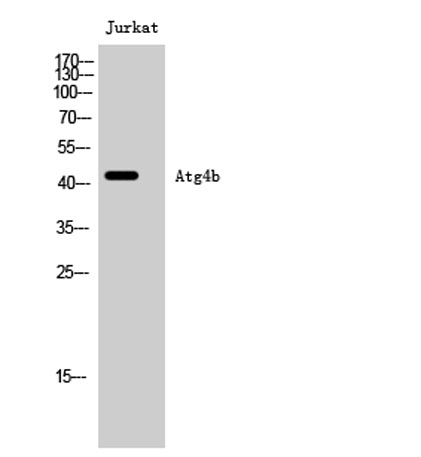 Western Blot analysis of Jurkat cells using Atg4b Polyclonal Antibody
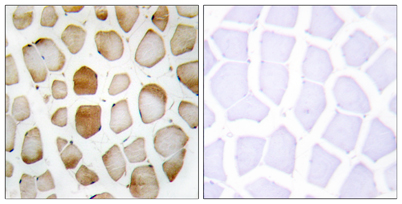 Immunohistochemistry analysis of paraffin-embedded human skeletal muscle tissue, using ATG4B Antibody. The picture on the right is blocked with the synthesized peptide.
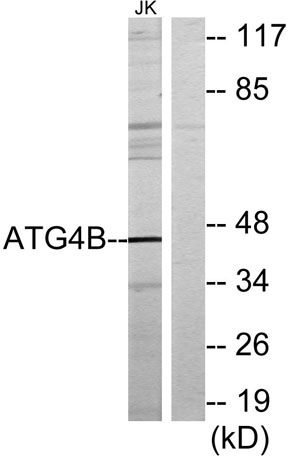 Western blot analysis of lysates from Jurkat cells, using ATG4B Antibody. The lane on the right is blocked with the synthesized peptide.