1
/
of
1
ELK Biotechnology
SKU:ES4961
DGK-θ Rabbit Polyclonal Antibody
Regular price
$248.00 USD
Regular price
Sale price
$248.00 USD
Unit price
/
per
Shipping calculated at checkout.
Couldn't load pickup availability
DGK-θ Rabbit Polyclonal Antibody
Overview
| Product name: | DGK-θ rabbit pAb |
| Alternative Names: | DGKQ; DAGK4; Diacylglycerol kinase theta; DAG kinase theta; Diglyceride kinase theta; DGK-theta |
| Applications: | WB;IHC;IF;ELISA |
| Recommended Dilutions: | Western Blot: 1/500 - 1/2000. Immunohistochemistry: 1/100 - 1/300. ELISA: 1/10000. Not yet tested in other applications. |
| Immunogen: | The antiserum was produced against synthesized peptide derived from human DGKQ. AA range:691-740 |
| Storage: | Rabbit |
| Storage: | -20°C/1 year |
| Clonality: | Polyclonal |
| Isotype: | IgG |
| Concentration: | 1 mg/ml |
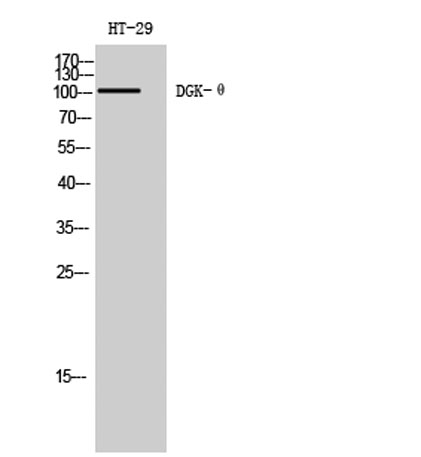
| Observed Band: | 101kD |
| GeneID(Human): | 1609 |
| Human Swiss-Prot No: | P52824 |
| Cellular localization: | Cytoplasm . Cytoplasm, cytosol . Cell membrane . Cell junction, synapse . Cytoplasm, cytoskeleton . Nucleus . Nucleus speckle . Nucleus matrix . Translocates to the plasma membrane in response to steroid hormone receptor stimulation (PubMed:15632189). Translocation to the plasma membrane is dependent on G-protein coupled receptor stimulation and subsequent activation of PRKCE and probably PRKCH (PubMed:15632189). Translocates to the nucleus in response to thrombin stimulation (Probable). Association with the nuclear matrix is regulated by nerve growth factor (By similarity). . |
| Background: | The protein encoded by this gene contains three cysteine-rich domains, a proline-rich region, and a pleckstrin homology domain with an overlapping Ras-associating domain. It is localized in the speckle domains of the nucleus, and mediates the regeneration of phosphatidylinositol (PI) from diacylglycerol in the PI-cycle during cell signal transduction. [provided by RefSeq, Jul 2008], |
| Species Reactivity: | Human;Rat;Mouse; |
-
Western Blot analysis of HT-29 cells using DGK-θ Polyclonal Antibody -
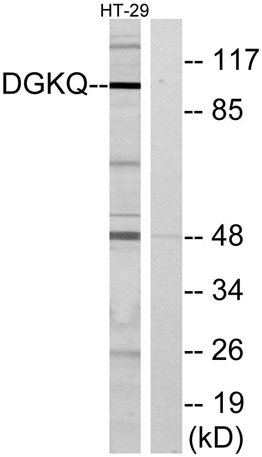
Western blot analysis of lysates from HT-29 cells, using DGKQ Antibody. The lane on the right is blocked with the synthesized peptide. -
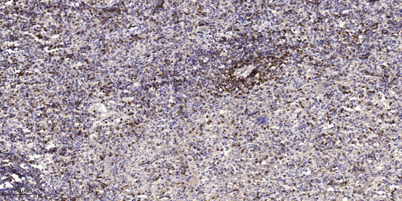
Immunohistochemical analysis of paraffin-embedded human spleen tissue. 1,primary Antibody was diluted at 1:200(4° overnight). 2, Sodium citrate pH 6.0 was used for antigen retrieval(>98°C,20min). 3,Secondary antibody was diluted at 1:200
Share