COX7A2P2; COX7A3; COX7AL2; COX7AP2; Putative cytochrome c oxidase subunit 7A3; mitochondrial; Cytochrome c oxidase subunit VIIa 3; COX7A2; COX7AL; Cytochrome c oxidase subunit 7A2, mitochondrial; Cytochrome c oxidase subunit VIIa-liver/hear
Applications:
WB;IHC;IF;ELISA
Recommended Dilutions:
Western Blot: 1/500 - 1/2000. Immunohistochemistry: 1/100 - 1/300. ELISA: 1/10000. Not yet tested in other applications.
Immunogen:
The antiserum was produced against synthesized peptide derived from human COX7S/A2. AA range:1-50
Storage:
Rabbit
Storage:
-20°C/1 year
Clonality:
Polyclonal
Isotype:
IgG
Concentration:
1 mg/ml
Observed Band:
12kD
GeneID(Human):
1347
Human Swiss-Prot No:
O60397/P14406
Cellular localization:
Mitochondrion inner membrane .
Background:
Cytochrome c oxidase, the terminal component of the mitochondrial respiratory chain, catalyzes the electron transfer from reduced cytochrome c to oxygen. This component is a heteromeric complex consisting of three catalytic subunits encoded by mitochondrial genes, and multiple structural subunits encoded by nuclear genes. The mitochondrially-encoded subunits function in electron transfer, while the nuclear-encoded subunits may function in the regulation and assembly of the complex. This nuclear gene encodes polypeptide 2 (liver isoform) of subunit VIIa, with this polypeptide being present in both muscle and non-muscle tissues. In addition to polypeptide 2, subunit VIIa includes polypeptide 1 (muscle isoform), which is present only in muscle tissues, and a related protein, which is present in all tissues. Alternative splicing results in multiple transcript variants. Related pseudogenes have been identified on chromosomes 4 and 14.


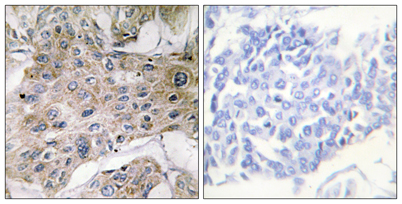 Immunohistochemistry analysis of paraffin-embedded human breast carcinoma tissue, using COX7S/A2 Antibody. The picture on the right is blocked with the synthesized peptide.
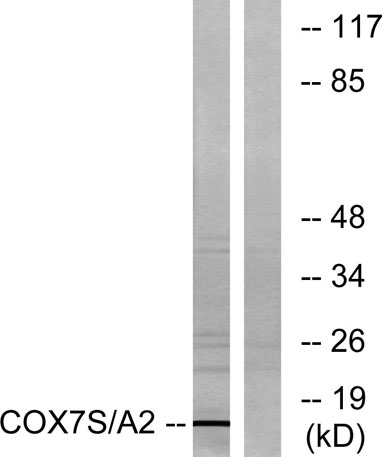 Western blot analysis of lysates from rat heart cells, using COX7S/A2 Antibody. The lane on the right is blocked with the synthesized peptide.