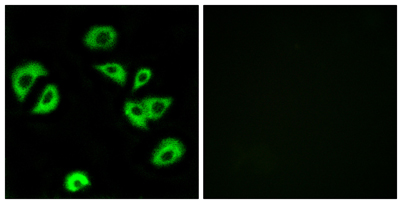
LILRB4; ILT3; LIR5; Leukocyte immunoglobulin-like receptor subfamily B member 4; CD85 antigen-like family member K; Immunoglobulin-like transcript 3; ILT-3; Leukocyte immunoglobulin-like receptor 5; LIR-5; Monocyte inhibitory receptor HM18;
Applications:
IF;ELISA
Recommended Dilutions:
Immunofluorescence: 1/200 - 1/1000. ELISA: 1/20000. Not yet tested in other applications.
Immunogen:
The antiserum was produced against synthesized peptide derived from human LILRB4. AA range:201-250
Storage:
Rabbit
Storage:
-20°C/1 year
Clonality:
Polyclonal
Isotype:
IgG
Concentration:
1 mg/ml
GeneID(Human):
11006
Human Swiss-Prot No:
Q8NHJ6
Cellular localization:
Cell membrane ; Single-pass type I membrane protein . Ligand binding leads to internalization and translocation to an antigen-processing compartment. .
Background:
This gene is a member of the leukocyte immunoglobulin-like receptor (LIR) family, which is found in a gene cluster at chromosomal region 19q13.4. The encoded protein belongs to the subfamily B class of LIR receptors which contain two or four extracellular immunoglobulin domains, a transmembrane domain, and two to four cytoplasmic immunoreceptor tyrosine-based inhibitory motifs (ITIMs). The receptor is expressed on immune cells where it binds to MHC class I molecules on antigen-presenting cells and transduces a negative signal that inhibits stimulation of an immune response. The receptor can also function in antigen capture and presentation. It is thought to control inflammatory responses and cytotoxicity to help focus the immune response and limit autoreactivity. Multiple transcript variants encoding different isoforms have been found for this gene. [provided by RefSeq, Jul 2