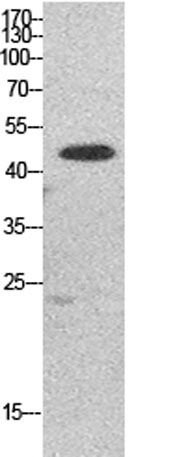
Western Blot: 1/500 - 1/2000. ELISA: 1/20000. Not yet tested in other applications.
Immunogen:
Synthesized peptide derived from the N-terminal region of human EF-1 α1/2.
Storage:
-20°C/1 year
Storage:
Rabbit
Clonality:
Polyclonal
Isotype:
IgG
Concentration:
1 mg/ml
Observed Band:
50kD
GeneID(Human):
1915/1917
Human Swiss-Prot No:
P68104/Q05639/Q5VTE0
Cellular localization:
Cytoplasm . Nucleus . Nucleus, nucleolus . Cell membrane . Colocalizes with DLC1 at actin-rich regions in the cell periphery (PubMed:19158340). Translocates together with ZPR1 from the cytoplasm to the nucleus and nucleolus after treatment with mitogens (PubMed:8650580). Localization at the cell membrane depends on EEF1A1 phosphorylation status and the presence of PPP1R16B (PubMed:26497934). .
Background:
This gene encodes an isoform of the alpha subunit of the elongation factor-1 complex, which is responsible for the enzymatic delivery of aminoacyl tRNAs to the ribosome. This isoform (alpha 1) is expressed in brain, placenta, lung, liver, kidney, and pancreas, and the other isoform (alpha 2) is expressed in brain, heart and skeletal muscle. This isoform is identified as an autoantigen in 66% of patients with Felty syndrome. This gene has been found to have multiple copies on many chromosomes, some of which, if not all, represent different pseudogenes. [provided by RefSeq, Jul 2008],