Western Blot: 1/500 - 1/2000. IHC-p: 1:100-300 ELISA: 1/20000. Not yet tested in other applications.
Immunogen:
The antiserum was produced against synthesized peptide derived from the Internal region of human SIGLEC7. AA range:51-100
Storage:
Rabbit
Storage:
-20°C/1 year
Clonality:
Polyclonal
Isotype:
IgG
Concentration:
1 mg/ml
Observed Band:
51kD
GeneID(Human):
27036
Human Swiss-Prot No:
Q9Y286
Cellular localization:
Membrane; Single-pass type I membrane protein.
Background:
domain:Contains 1 copy of a cytoplasmic motif that is referred to as the immunoreceptor tyrosine-based inhibitor motif (ITIM). This motif is involved in modulation of cellular responses. The phosphorylated ITIM motif can bind the SH2 domain of several SH2-containing phosphatases.,function:Putative adhesion molecule that mediates sialic-acid dependent binding to cells. Preferentially binds to alpha-2,3- and alpha-2,6-linked sialic acid. Also binds disialogangliosides (disialogalactosyl globoside, disialyl lactotetraosylceramide and disialyl GalNAc lactotetraoslylceramide). The sialic acid recognition site may be masked by cis interactions with sialic acids on the same cell surface. In the immune response, may act as an inhibitory receptor upon ligand induced tyrosine phosphorylation by recruiting cytoplasmic phosphatase(s) via their SH2 domain(s) that block signal transduction through dephosphorylation of signaling molecules. Mediates inhibition of natural killer cells cytotoxicity. May play a role in hemopoiesis. Inhibits differentiation of CD34+ cell precursors towards myelomonocytic cell lineage and proliferation of leukemic myeloid cells (in vitro).,online information:Siglec-7,PTM:Tyrosine phosphorylated.,similarity:Belongs to the immunoglobulin superfamily. SIGLEC (sialic acid binding Ig-like lectin) family.,similarity:Contains 1 Ig-like V-type (immunoglobulin-like) domain.,similarity:Contains 2 Ig-like C2-type (immunoglobulin-like) domains.,subunit:Interacts with PTPN6/SHP-1 upon phosphorylation.,tissue specificity:Predominantly expressed by resting and activated natural killer cells and at lower levels by granulocytes and monocytes. High expression found in placenta, liver, lung, spleen, and peripheral blood leukocytes.,


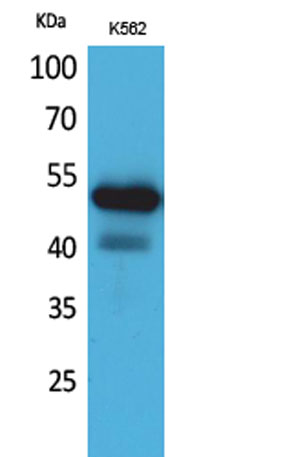 Western Blot analysis of K562 cells using CD328 Polyclonal Antibody. Secondary antibody(catalog#:RS0002) was diluted at 1:20000
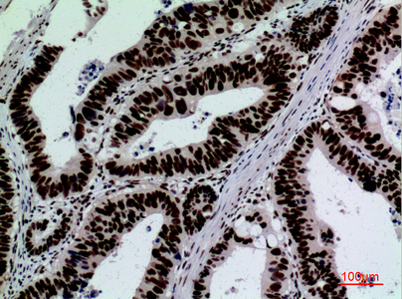 Immunohistochemical analysis of paraffin-embedded human-colon-cancer, antibody was diluted at 1:100
 Immunohistochemical analysis of paraffin-embedded human-colon-cancer, antibody was diluted at 1:100
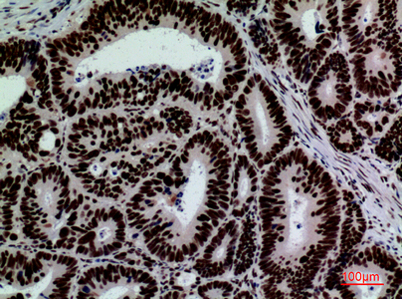 Immunohistochemical analysis of paraffin-embedded human-colon-cancer, antibody was diluted at 1:100