SSX1; Protein SSX1; Cancer/testis antigen 5.1; CT5.1; Synovial sarcoma, X breakpoint 1; SSX2; SSX2A; SSX2B; Protein SSX2; Cancer/testis antigen 5.2; CT5.2; Synovial sarcoma, X breakpoint 2; Tumor antigen HOM-MEL-40; SSX3; Protein SSX3;Cancer/testis antigen 5.3; CT5.3; SSX4; SSX4A; SSX4B; Protein SSX4; Cancer/testis antigen 5.4; CT5.4; SSX5; Protein SSX5; SSX6; Putative protein SSX6; SSX7; Protein SSX7; SSX8; Protein SSX8; SSX9; Protein SSX9
Applications:
WB;IHC;IF;ELISA
Recommended Dilutions:
Western Blot: 1/500 - 1/2000. IHC-p: 1:100-300 ELISA: 1/20000. Not yet tested in other applications.
Immunogen:
The antiserum was produced against synthesized peptide derived from the C-terminal region of human SSX1/2/3/4/5/6/7/8/9. AA range:139-188
Storage:
Rabbit
Storage:
-20°C/1 year
Clonality:
Polyclonal
Isotype:
IgG
Concentration:
1 mg/ml
Observed Band:
25kD
GeneID(Human):
6756
Human Swiss-Prot No:
Q16384
Cellular localization:
nucleus,
Background:
The product of this gene belongs to the family of highly homologous synovial sarcoma X (SSX) breakpoint proteins. These proteins may function as transcriptional repressors. They are also capable of eliciting spontaneous humoral and cellular immune responses in cancer patients, and are potentially useful targets in cancer vaccine-based immunotherapy. This gene, and also the SSX2 and SSX4 family members, have been involved in t(X;18)(p11.2;q11.2) translocations that are characteristically found in all synovial sarcomas. This translocation results in the fusion of the synovial sarcoma translocation gene on chromosome 18 to one of the SSX genes on chromosome X. The encoded hybrid proteins are likely responsible for transforming activity. Alternative splicing of this gene results in multiple transcript variants. A related pseudogene has been identified on chromosome X. [provided by RefSeq, Jul 2013],


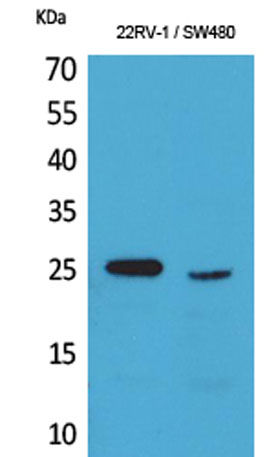 Western Blot analysis of 22RV-1, SW480 cells using SSX Polyclonal Antibody. Secondary antibody(catalog#:RS0002) was diluted at 1:20000
 Immunohistochemical analysis of paraffin-embedded human-skin, antibody was diluted at 1:100
 Western blot analysis of lysate from 22RV-1 cells, using SSX1/2/3/4/5/6/7/8/9 Antibody.