1
/
of
1
ELK Biotechnology
SKU:ES3343
RFC3 Rabbit Polyclonal Antibody
Regular price
$248.00 USD
Regular price
Sale price
$248.00 USD
Unit price
/
per
Shipping calculated at checkout.
Couldn't load pickup availability
RFC3 Rabbit Polyclonal Antibody
Overview
| Product name: | RFC3 rabbit pAb |
| Alternative Names: | RFC3; Replication factor C subunit 3; Activator 1 38 kDa subunit; A1 38 kDa subunit; Activator 1 subunit 3; Replication factor C 38 kDa subunit; RF-C 38 kDa subunit; RFC38 |
| Applications: | WB;IHC;IF;ELISA |
| Recommended Dilutions: | Western Blot: 1/500 - 1/2000. Immunohistochemistry: 1/100 - 1/300. ELISA: 1/40000. Not yet tested in other applications. |
| Immunogen: | The antiserum was produced against synthesized peptide derived from human RFC3. AA range:178-227 |
| Storage: | Rabbit |
| Storage: | -20°C/1 year |
| Clonality: | Polyclonal |
| Isotype: | IgG |
| Concentration: | 1 mg/ml |
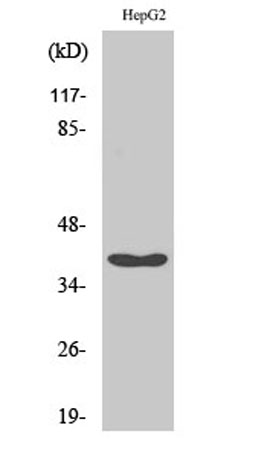
| Observed Band: | 40kD |
| GeneID(Human): | 5983 |
| Human Swiss-Prot No: | P40938 |
| Cellular localization: | Nucleus . |
| Background: | The elongation of primed DNA templates by DNA polymerase delta and DNA polymerase epsilon requires the accessory proteins proliferating cell nuclear antigen (PCNA) and replication factor C (RFC). RFC, also named activator 1, is a protein complex consisting of five distinct subunits of 140, 40, 38, 37, and 36 kDa. This gene encodes the 38 kDa subunit. This subunit is essential for the interaction between the 140 kDa subunit and the core complex that consists of the 36, 37, and 40 kDa subunits. Alternatively spliced transcript variants encoding distinct isoforms have been described. [provided by RefSeq, Jul 2008], |
| Species Reactivity: | Human;Mouse;Rat |
-
Western Blot analysis of various cells using RFC3 Polyclonal Antibody cells nucleus extracted by Minute TM Cytoplasmic and Nuclear Fractionation kit (SC-003,Inventbiotech,MN,USA). -
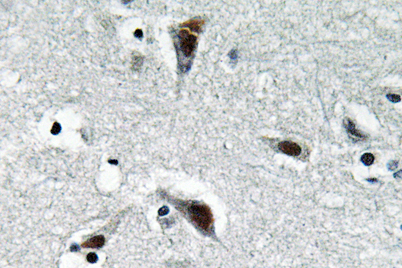
Immunohistochemistry analysis of RFC3 antibody in paraffin-embedded human brain tissue. -
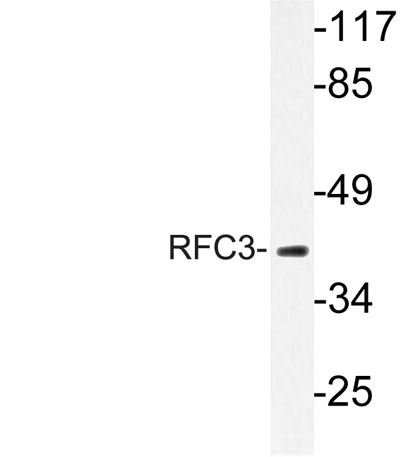
Western blot analysis of lysate from HepG2 cells, using RFC3 antibody.

Share