IFIH1; MDA5; RH116; Interferon-induced helicase C domain-containing protein 1; Clinically amyopathic dermatomyositis autoantigen 140 kDa; CADM-140 autoantigen; Helicase with 2 CARD domains; Helicard; Interferon-induced with helicase C domai
Applications:
WB;IHC;IF;ELISA
Recommended Dilutions:
Western Blot: 1/500 - 1/2000. Immunohistochemistry: 1/100 - 1/300. ELISA: 1/40000. Not yet tested in other applications.
Immunogen:
The antiserum was produced against synthesized peptide derived from human IFIH1. AA range:976-1025
Storage:
Rabbit
Storage:
-20°C/1 year
Clonality:
Polyclonal
Isotype:
IgG
Concentration:
1 mg/ml
Observed Band:
120kD
GeneID(Human):
64135
Human Swiss-Prot No:
Q9BYX4
Cellular localization:
Cytoplasm . Nucleus . Mitochondrion . Upon viral RNA stimulation and ISGylation, translocates from cytosol to mitochondrion. May be found in the nucleus, during apoptosis.
Background:
DEAD box proteins, characterized by the conserved motif Asp-Glu-Ala-Asp (DEAD), are putative RNA helicases. They are implicated in a number of cellular processes involving alteration of RNA secondary structure such as translation initiation, nuclear and mitochondrial splicing, and ribosome and spliceosome assembly. Based on their distribution patterns, some members of this family are believed to be involved in embryogenesis, spermatogenesis, and cellular growth and division. This gene encodes a DEAD box protein that is upregulated in response to treatment with beta-interferon and a protein kinase C-activating compound, mezerein. Irreversible reprogramming of melanomas can be achieved by treatment with both these agents; treatment with either agent alone only achieves reversible differentiation. Genetic variation in this gene is associated with diabetes mellitus insulin-depend


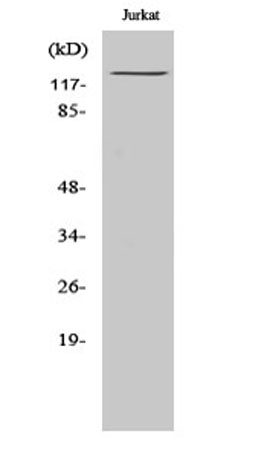 Western Blot analysis of various cells using MDA5 Polyclonal Antibody
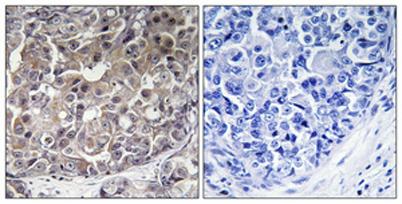 Immunohistochemical analysis of paraffin-embedded Human breast cancer. Antibody was diluted at 1:100(4° overnight). High-pressure and temperature Tris-EDTA,pH8.0 was used for antigen retrieval. Negetive contrl (right) obtaned from antibody was pre-absor
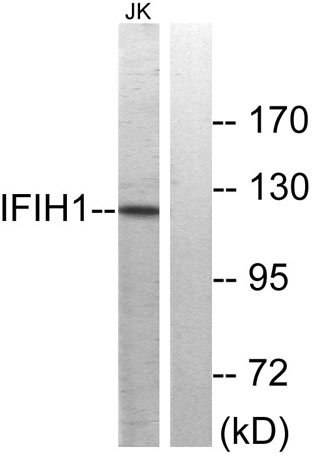 Western blot analysis of lysates from Jurkat cells, using IFIH1 Antibody. The lane on the right is blocked with the synthesized peptide.