1
/
of
1
ELK Biotechnology
SKU:ES2428
GK1 Rabbit Polyclonal Antibody
Regular price
$248.00 USD
Regular price
Sale price
$248.00 USD
Unit price
/
per
Shipping calculated at checkout.
Couldn't load pickup availability
GK1 Rabbit Polyclonal Antibody
Overview
| Product name: | GK1 rabbit pAb |
| Alternative Names: | GK; Glycerol kinase; GK; Glycerokinase; ATP:glycerol 3-phosphotransferase |
| Applications: | WB;IF;ELISA |
| Recommended Dilutions: | Western Blot: 1/500 - 1/2000. Immunofluorescence: 1/200 - 1/1000. ELISA: 1/20000. Not yet tested in other applications. |
| Immunogen: | The antiserum was produced against synthesized peptide derived from human GK. AA range:461-510 |
| Storage: | Rabbit |
| Storage: | -20°C/1 year |
| Clonality: | Polyclonal |
| Isotype: | IgG |
| Concentration: | 1 mg/ml |
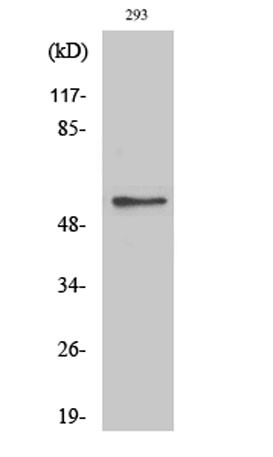
| Observed Band: | 57kD |
| GeneID(Human): | 2710 |
| Human Swiss-Prot No: | P32189 |
| Cellular localization: | Mitochondrion outer membrane; Peripheral membrane protein; Cytoplasmic side. Cytoplasm. In sperm and fetal tissues, the majority of the enzyme is bound to mitochondria, but in adult tissues, such as liver found in the cytoplasm. |
| Background: | The protein encoded by this gene belongs to the FGGY kinase family. This protein is a key enzyme in the regulation of glycerol uptake and metabolism. It catalyzes the phosphorylation of glycerol by ATP, yielding ADP and glycerol-3-phosphate. Mutations in this gene are associated with glycerol kinase deficiency (GKD). Alternatively spliced transcript variants encoding different isoforms have been found for this gene. [provided by RefSeq, Mar 2011], |
| Species Reactivity: | Human;Mouse;Rat |
-
Western Blot analysis of various cells using GK1 Polyclonal Antibody diluted at 1:2000 -
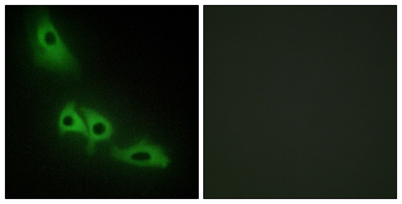
Immunofluorescence analysis of HeLa cells, using GK Antibody. The picture on the right is blocked with the synthesized peptide. -
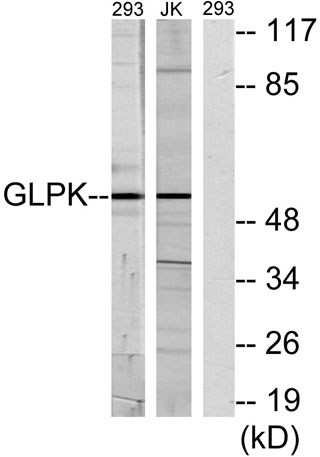
Western blot analysis of lysates from 293 and Jurkat cells, using GK Antibody. The lane on the right is blocked with the synthesized peptide.

Share