Western Blot: 1/500 - 1/2000. Immunohistochemistry: 1/100 - 1/300. Immunofluorescence: 1/200 - 1/1000. ELISA: 1/10000. Not yet tested in other applications.
Immunogen:
The antiserum was produced against synthesized peptide derived from human FGFR1 Oncogene Partner. AA range:341-390
Storage:
Rabbit
Storage:
-20°C/1 year
Clonality:
Polyclonal
Isotype:
IgG
Concentration:
1 mg/ml
Observed Band:
43kD
GeneID(Human):
11116
Human Swiss-Prot No:
O95684
Cellular localization:
Cytoplasm, cytoskeleton, microtubule organizing center, centrosome . Cytoplasm, cytoskeleton, microtubule organizing center, centrosome, centriole . Cytoplasm, cytoskeleton, cilium basal body . Associated with gamma-tubulin (PubMed:16314388). Localizes on both mother and daughter centrioles (PubMed:28625565, PubMed:28428259). Localizes to an axial position on the mother centriole (PubMed:28625565). Localizes to the distal end of the centriole partly on the subdistal appendage region (PubMed:28659385). .
Background:
FGFR1 oncogene partner(FGFR1OP) Homo sapiens This gene encodes a largely hydrophilic centrosomal protein that is required for anchoring microtubules to subcellular structures. A t(6;8)(q27;p11) chromosomal translocation, fusing this gene and the fibroblast growth factor receptor 1 (FGFR1) gene, has been found in cases of myeloproliferative disorder. The resulting chimeric protein contains the N-terminal leucine-rich region of this encoded protein fused to the catalytic domain of FGFR1. Alterations in this gene may also be associated with Crohn's disease, Graves' disease, and vitiligo. Alternatively spliced transcript variants that encode different proteins have been identified. [provided by RefSeq, Jul 2013],


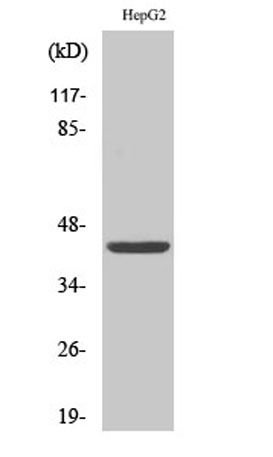 Western Blot analysis of various cells using FOP Polyclonal Antibody
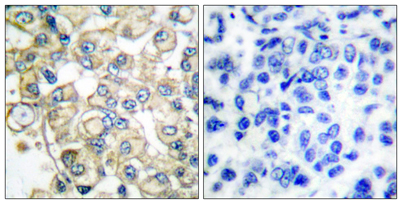 Immunohistochemistry analysis of paraffin-embedded human breast carcinoma tissue, using FGFR1 Oncogene Partner Antibody. The picture on the right is blocked with the synthesized peptide.
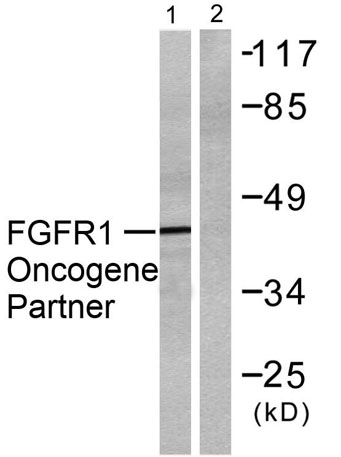 Western blot analysis of lysates from HepG2 cells, using FGFR1 Oncogene Partner Antibody. The lane on the right is blocked with the synthesized peptide.