1
/
of
1
ELK Biotechnology
SKU:ES2032
Cox-1 Rabbit Polyclonal Antibody
Regular price
$248.00 USD
Regular price
Sale price
$248.00 USD
Unit price
/
per
Shipping calculated at checkout.
Couldn't load pickup availability
Cox-1 Rabbit Polyclonal Antibody
Overview
| Product name: | Cox-1 rabbit pAb |
| Alternative Names: | PTGS1; COX1; Prostaglandin G/H synthase 1; Cyclooxygenase-1; COX-1; Prostaglandin H2 synthase 1; PGH synthase 1; PGHS-1; PHS 1; Prostaglandin-endoperoxide synthase 1 |
| Applications: | WB;IHC;IF;ELISA |
| Recommended Dilutions: | Western Blot: 1/500 - 1/2000. Immunohistochemistry: 1/100 - 1/300. ELISA: 1/40000. Not yet tested in other applications. |
| Immunogen: | The antiserum was produced against synthesized peptide derived from human Cox1. AA range:550-599 |
| Storage: | Rabbit |
| Storage: | -20°C/1 year |
| Clonality: | Polyclonal |
| Isotype: | IgG |
| Concentration: | 1 mg/ml |
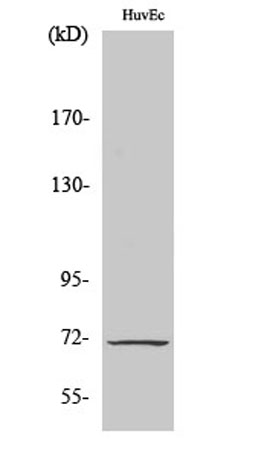
| Observed Band: | 70kD |
| GeneID(Human): | 5742 |
| Human Swiss-Prot No: | P23219 |
| Cellular localization: | Microsome membrane; Peripheral membrane protein. Endoplasmic reticulum membrane; Peripheral membrane protein. |
| Background: | This is one of two genes encoding similar enzymes that catalyze the conversion of arachinodate to prostaglandin. The encoded protein regulates angiogenesis in endothelial cells, and is inhibited by nonsteroidal anti-inflammatory drugs such as aspirin. Based on its ability to function as both a cyclooxygenase and as a peroxidase, the encoded protein has been identified as a moonlighting protein. The protein may promote cell proliferation during tumor progression. Alternative splicing results in multiple transcript variants. [provided by RefSeq, Jan 2014], |
| Species Reactivity: | Human;Rat;Mouse; |
-
Western Blot analysis of various cells using Cox-1 Polyclonal Antibody -
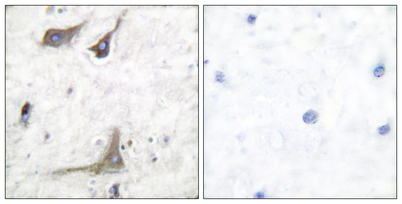
Immunohistochemistry analysis of paraffin-embedded human brain tissue, using Cox1 Antibody. The picture on the right is blocked with the synthesized peptide. -
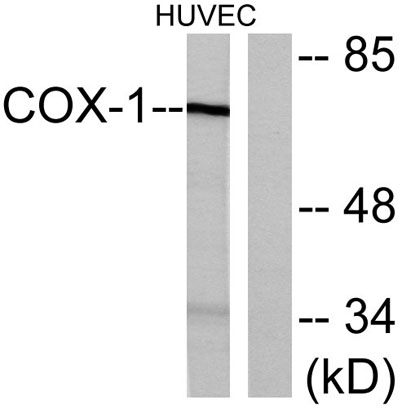
Western blot analysis of lysates from HUVEC cells, using Cox1 Antibody. The lane on the right is blocked with the synthesized peptide.

Share